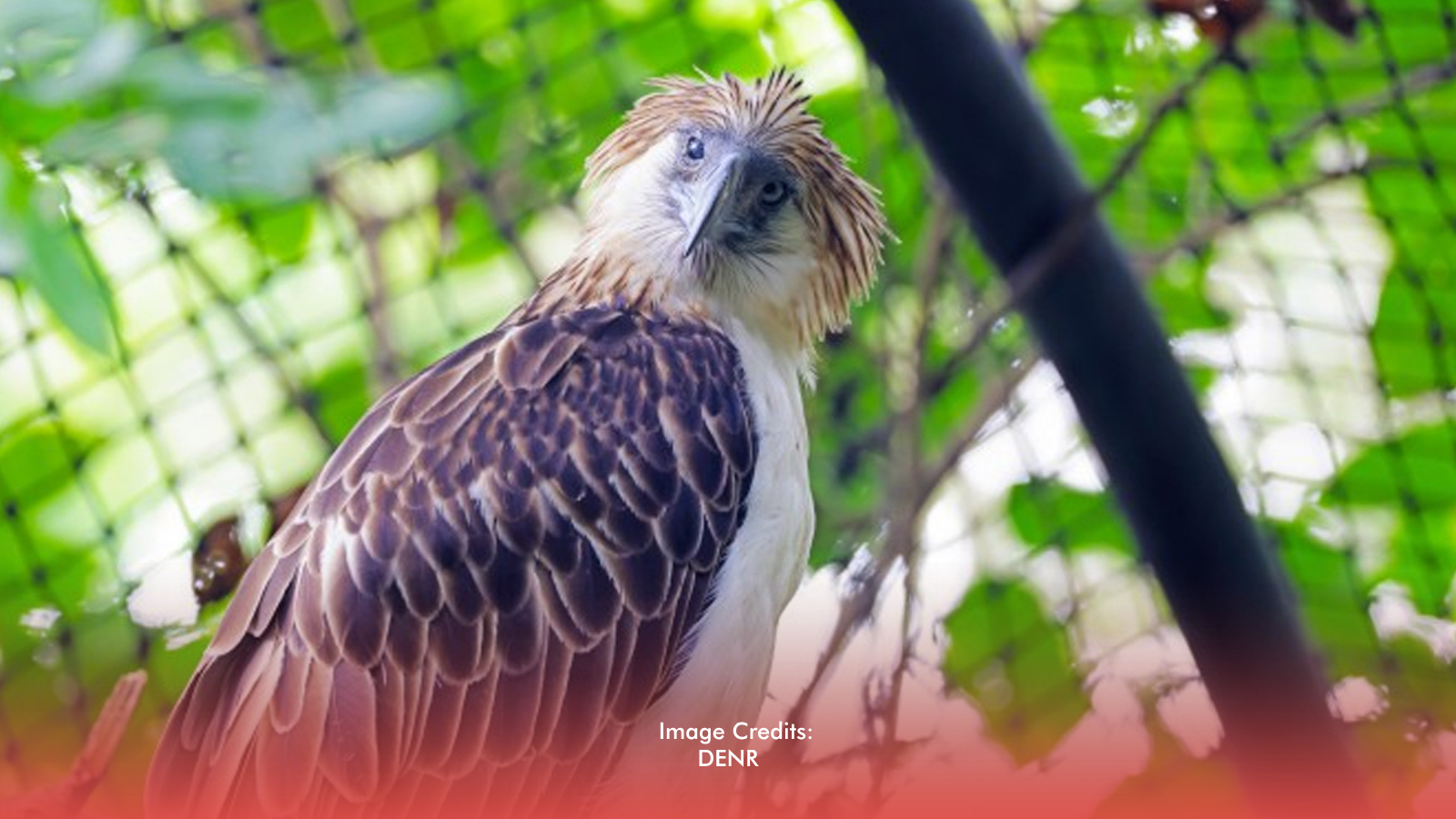
A Philippine Eagle rescued in the early 1980s has surpassed the expected lifespan of its species in captivity, becoming a living symbol of long-term conservation progress in the Philippines.
The Department of Environment and Natural Resources (DENR) confirmed that “Girlie,” rescued in 1982 after a slingshot injury left her with a damaged wing and blindness in one eye, is now in her mid-40s—well beyond the typical lifespan of Philippine Eagles in managed care.
She has been under human care since her rescue and has been housed at the Ninoy Aquino Parks and Wildlife Center in Quezon City since 2009.
From Rescue to Conservation Milestone
Girlie became part of early captive-breeding efforts in the 1980s when she was paired with a male eagle named Tsai. The pair produced the first fertile egg laid by a naturally paired Philippine Eagle in captivity, a milestone in local conservation history.
Although the chick did not survive, the achievement helped shift conservation strategy toward long-term habitat protection and science-based recovery rather than breeding alone.
DENR Secretary Juan Miguel Cuna said Girlie reflects decades of cooperation between government and conservation partners.
“Government brings policy and reach; PEF brings field science and years of hands-on experience,” he said.
A Species Still Under Threat
The Philippine Eagle, found only in parts of Luzon, Samar, Leyte, and Mindanao, is one of the world’s rarest raptors and is listed as critically endangered, with an estimated 400 breeding pairs remaining in the wild.
Conservation efforts today focus on protecting remaining forest habitats and strengthening enforcement to safeguard nesting territories.
Philippine Eagle Foundation Executive Director Dennis Salvador said long-term field research has been essential in guiding national policy, including nest monitoring, territory mapping, and population tracking.
“Saving our National Bird requires basing our joint actions on verified field data,” he said.
A Living Reminder
Now one of the longest-living Philippine Eagles in captivity, Girlie has also become an educational figure for visitors at the Quezon City wildlife center.
Her presence offers a rare public encounter with the national bird and highlights the fragility of its survival in the wild.
While she can no longer return to nature, her life reflects decades of steady conservation work—measured not in quick wins, but in persistence over time.