
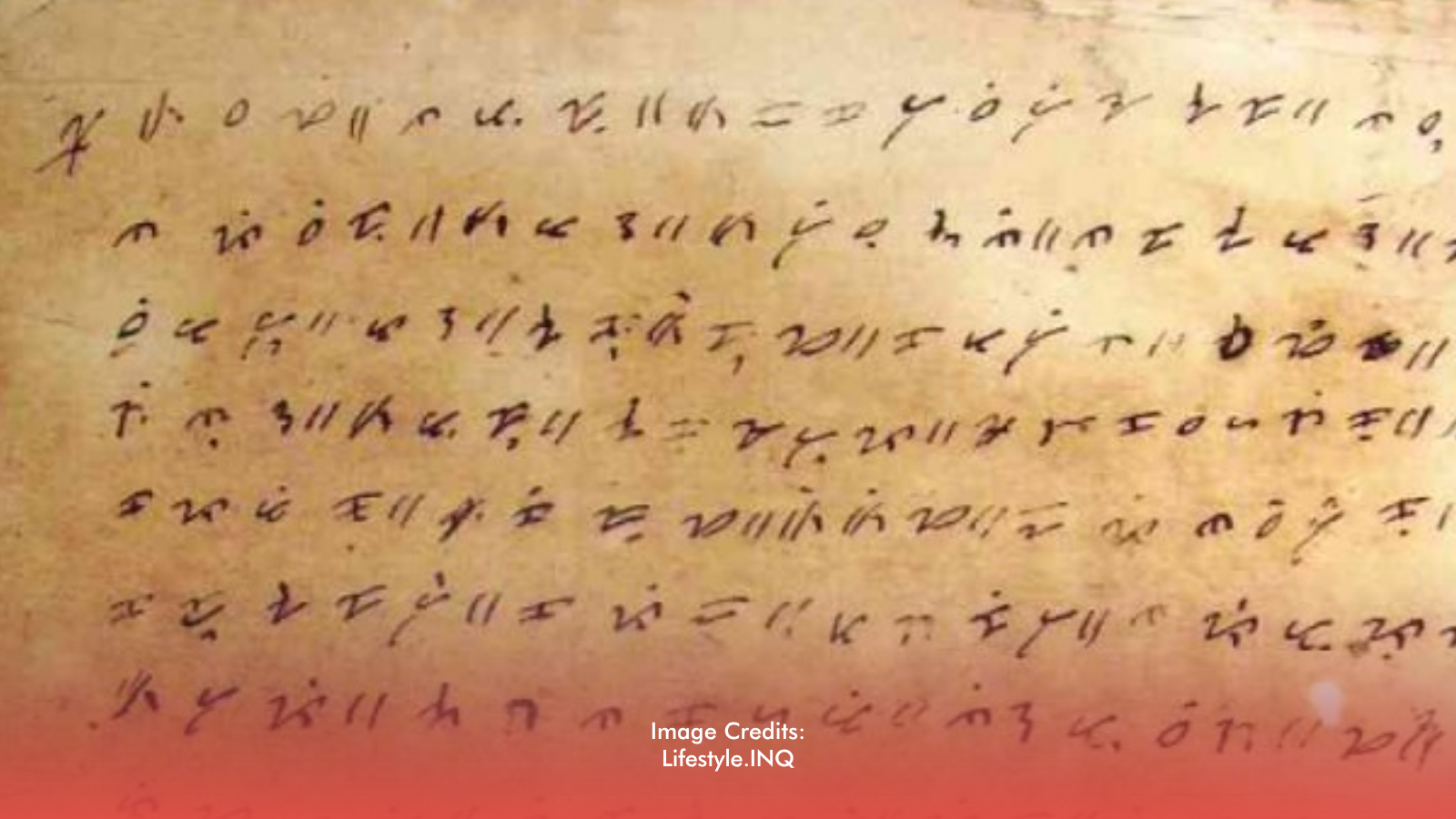
Long before Spain colonized the Philippines, we already had a writing system that helped cement our roots. Known as Baybayin, this was used not only by leaders or the elite but also by ordinary civilians for letters, poems, prayers, and incantations. And it has stood the test of time, with traces of it present in several creative mediums.
Etymology
“Baybayin” stems from the Tagalog word baybay, meaning “to spell.” It is an alphasyllabary: its characters represent syllables rather than individual letters, like the modern Latin alphabet. These are built around consonants with an inherent “a” sound, while a kudlit (either a dot, apostrophe, or comma) placed above or below changes the vowel sound.
Baybayin was one of several indigenous Philippine writing systems, with other traditions found among communities such as the Hanunoo and Buhid Mangyan, as well as the Tagbanua and Pala’wan of Palawan.
Presence Under Spanish Rule
What’s interesting is that Baybayin did not disappear when the Spaniards arrived. Friars studied the script and used it in their efforts to teach Catholicism. In fact, the Doctrina Christiana, one of the earliest books printed in the Philippines, included Baybayin alongside Latinized Tagalog.
That being said, usage of Baybayin declined over time due to wider usage of the Latin alphabet. Spanish writers also introduced changes to the script, such as a cross mark to represent consonants without the inherent vowel.
What About “Alibata?”
Now let’s address the elephant in the room: where did “Alibata” come from?
This was coined in 1914 by Filipino scholar Paul Rodriguez Verzosa, who based it on the first letters of the Arabic alphabet: alif, ba, and ta. However, Baybayin has no historical connection to the Arabic alphabet. The script belongs to the Brahmic family of writing systems found across South and Southeast Asia.
Alibata eventually appeared in newspapers and other writings, making it familiar to generations of Filipinos. But make no mistake: Baybayin is still the historically documented term.
Cultural Significance
Today, Baybayin is finding a new audience through art, fashion, tattoos, classrooms, workshops, and cultural programs. Organizations have also worked to spread awareness about it.
Beyond learning it as a script, Baybayin becomes a portal for us to reconnect with our history and identity. Similarly, preserving it means we remember it as one piece in a much larger tradition of indigenous Philippine writing.