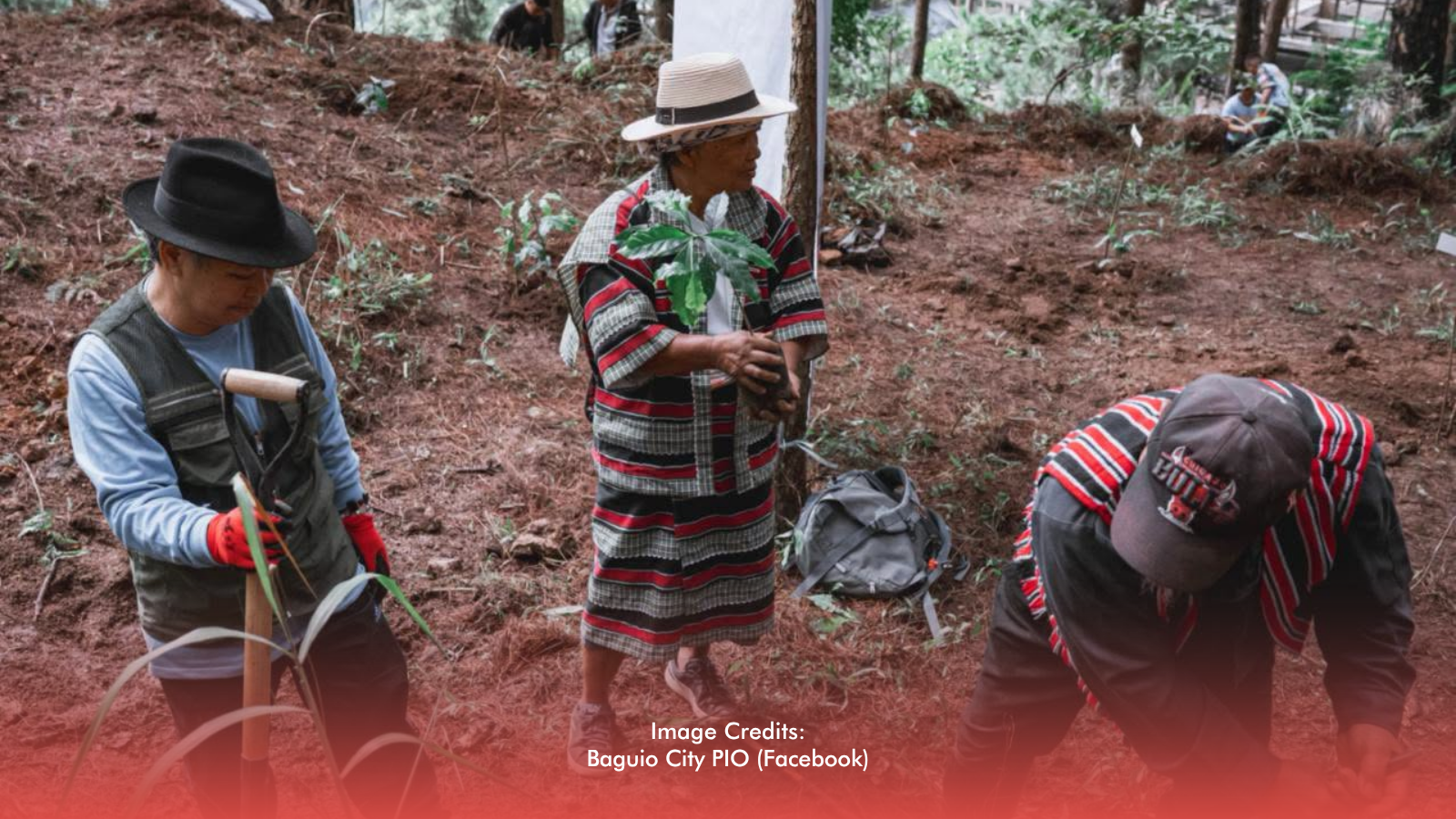
Baguio City has taken another step toward strengthening its local coffee industry after planting around 1,200 tree seedlings under its Community Coffee Tree Planting Program in Barangay Happy Hollow. The initiative seeks to increase arabica coffee production while advancing the city's circular economy efforts, helping local farmers improve productivity and create more sustainable sources of livelihood.
The tree-planting activity was held on June 26 at Purok 3, Barangay Happy Hollow and brought together Mayor Benjamin Magalong, representatives from the European Union-Philippine Green Economy Program (EU-GEP), the United Nations Development Program (UNDP), the City Veterinary and Agriculture Office (CVAO), Camp John Hay, the Baguio City Police Office led by Col. Ruel Tagel, barangay officials headed by Soriano Palunan, the Coffee Board, criminology interns from the University of the Cordilleras, and members of the local community.
Strengthening Baguio's Coffee Industry
Participants planted 1,000 certified arabica coffee seedlings along with 200 alnus seedlings supplied by the Bureau of Plant Industry of the Department of Agriculture-Cordillera Administrative Region. The activity supports the Coffee Heritage Project in Barangay Happy Hollow, one of the key farm-to-table initiatives under the city's Circular Tourism portfolio through the Pansa-nopen Tayo program.
The project has already enabled the barangay to establish its own coffee processing and upcycling facility, allowing locally harvested coffee beans to be processed into roasted coffee while minimizing agricultural waste. Through this facility, farmers from Happy Hollow recently supplied 90 kilograms of roasted coffee beans to the Newtown Hotel Group. The barangay also received a coffee grinder from the EU-GEP to further improve processing and increase the value of locally grown coffee.
To ensure the long-term sustainability of the initiative, city officials continue to encourage the expansion of arabica coffee production. The annual tree-planting program also fulfills Mayor Magalong's earlier commitment to provide additional manpower from the BCPO and partner agencies to help residents cultivate more coffee trees.
“We made the request with the commitment that the lot will be devoted only to coffee trees and no illegal structures will be built,” Mayor Magalong said as he discussed the proposal for Camp John Hay to allocate land dedicated to coffee tree propagation.
Supporting Farmers Through Circular Economy
The city's farm-to-table partnership directly connects local farmers with participating hotels, including the Newtown Hotel Group, enabling them to supply vegetables, fruits, mushrooms, and coffee sourced from farmer cooperatives and associations in Barangay Happy Hollow, Sto. Tomas, Dontogan, and Pinsao Proper with support from the CVAO.
As part of the circular economy model, kitchen waste collected from hotels and restaurants will be processed into compost by the city government and returned to farmers for agricultural use. A memorandum of agreement is expected to be signed soon to formalize the pilot project.
City officials said the system is expected to reduce postharvest losses, shorten the value chain, and increase farmers' incomes. Launched in February through a coffee business development workshop organized by the CVAO and the EU-GEP, the Coffee Heritage Project also aims to create more livelihood opportunities for Indigenous families, strengthen Baguio's local coffee supply, and position Happy Hollow as a key contributor to the city's growing specialty coffee industry.
Beyond expanding coffee production, the initiative offers long-term benefits for both farmers and consumers by promoting sustainable agriculture, supporting local businesses, and encouraging responsible waste management. As Baguio continues investing in community-based farming and circular economy practices, the project demonstrates how environmental sustainability and livelihood development can work together to strengthen local economies and improve the quality of life for Filipino communities.