In the 1660s, Jesuit missionary Francisco Ignacio Alcina documented this eerie tradition among Visayans. When a lunar eclipse darkened the sky, people struck their wooden rice mortars, known as lusung, and the floors of their houses to frighten the serpent away. Work stopped for the day, and the same rituals were performed when the moon turned blood red.
For these communities, the eclipse and the monster had the same name: bakunawa.
What Is the Bakunawa?
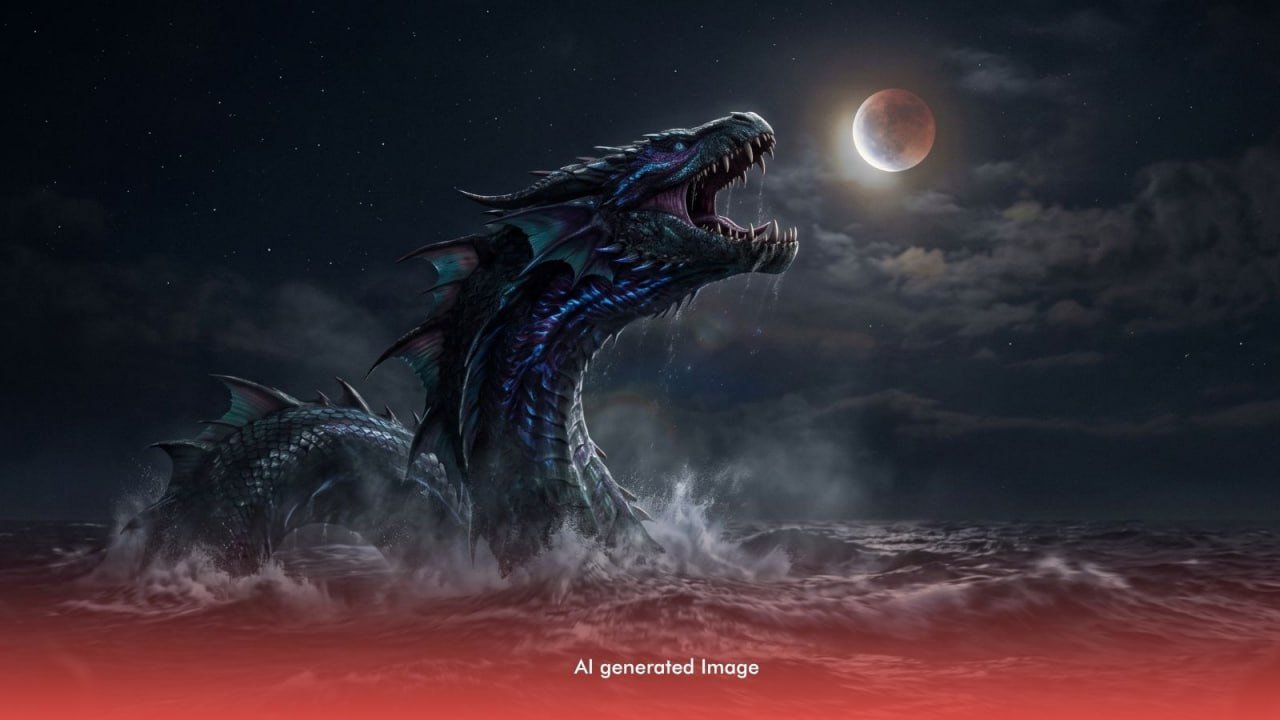
The bakunawa is a giant serpent from Visayan folklore believed to cause eclipses by swallowing the moon and, in some accounts, the sun. Often imagined as a sea dragon lurking beneath the waves, it emerges when the moon shines brightest, threatening to plunge the world into darkness.
Historical dictionaries support the creature's deep roots in local tradition. In 1668, Alcina recorded bakunawa as the Visayan term for a solar or lunar eclipse. An eighteenth-century dictionary also documented the phrase binabakunawahan an adlaw, meaning “the sun is being eaten by the bakunawa.”
An earlier Hiligaynon dictionary by Spanish friar Alonso de Méntrida described the bacunaua as a serpent that swallowed the moon.
The creature's name may have originated from old Austronesian roots associated with a curved shape and a large snake, although this proposed etymology remains uncertain.
What Does the Moon-Eating Serpent Look Like?
Descriptions of the bakunawa vary across stories and generations. Modern illustrations often portray it as a colossal sea dragon with enormous jaws, sharp teeth, whiskers, gills, scales and sometimes wings.
Some depictions show a creature so immense that it can circle the world or rise from the ocean to consume the moon in a single bite.
However, early Spanish accounts offered few physical details. To the Visayans documented by Alcina, the bakunawa was simply a gigantic serpent capable of swallowing a celestial body.
Whatever its appearance, its most frightening power was the same: making the moon disappear from the night sky.
Did You Know? The Rice Mortar Had Another Celestial Meaning
The word lusung, referring to the wooden rice mortar struck during an eclipse, was also recorded as an old Visayan name for the Big Dipper.
The connection adds another layer to the tradition. An ordinary household object used to pound rice became part of a ritual to protect a celestial body from a monster lurking in the darkness.
And the bakunawa was not the only creature Filipinos feared when the sky changed.
Other Philippine Creatures Said to Swallow the Moon
Across the archipelago, different communities developed their own explanations for eclipses.
- Tagalog: The term laho referred to an eclipse, with historical expressions describing the creature swallowing the moon.
- Kapampangan: The related term lawo appears in accounts of eclipse beliefs.
- Bagobo: The minokawa, a gigantic bird, was believed to swallow the moon.
- Maranao: The arimaonga, a lion-like creature, was associated with eclipses.
- Mandaya and Manobo: Some traditions featured the giant crab known as the tambanakua.
The response was often similar: make noise to frighten the creature away.
A Spanish priest writing around 1731 described people gathering in streets and open fields, striking bells and clay pots with tremendous force to save the moon from what he called a dragon, tiger or crocodile. In Basilan in 1886, a Jesuit also recorded Muslims making noise with gongs during a lunar eclipse to scare away a serpent believed to be eating the moon.
The Legend of the Bakunawa and the Seven Moons
One of the best-known versions of the legend is The Bakunawa and the Seven Moons, recorded in Cebuano by writer Fernando Buyser in the early twentieth century.
In this telling, Bathala created seven moons to illuminate the seven nights of the week. But the bakunawa emerged from the sea and swallowed six of them, leaving the world in danger of losing its heavenly lights.
When the serpent returned for the last moon, people rushed outside and beat drums, pots and metal objects. Their thunderous cries and clanging instruments frightened the creature into spitting the moon back out.
To protect the surviving moon, Bathala planted bamboo on its surface. According to the legend, the dark markings visible on the moon are traces of that bamboo.
The story has been retold in different versions, including later adaptations by folklorist Damiana Eugenio. As a result, some details differ across modern accounts.
Why Did People Believe the Bakunawa Ate the Moon?
Before modern astronomy explained eclipses, many cultures interpreted the sudden disappearance of the moon as an attack by a supernatural creature. Making noise seemed to work because the moon eventually returned to view.
Philippine eclipse traditions also share similarities with South and Southeast Asian mythology. In Hindu and Buddhist traditions, Rahu is a celestial demon associated with swallowing the sun and moon. Because he cannot hold them indefinitely, the celestial bodies eventually reappear.
Historian Juan R. Francisco argued that the Tagalog term laho may have originated from Rahu, possibly entering the language through Malay. Other writers have explored possible connections between the bakunawa, Rahu and the naga, the great serpents of Asian mythology.
However, the precise origins of the bakunawa legend remain debated. Its similarities to other traditions do not establish a single source for the story.
The Bakunawa in Modern Culture
Today, the bakunawa remains one of the most recognizable creatures in Philippine mythology, appearing in fantasy art, tattoos, literature and games.
Its story has also reached the performing arts. In 1974, composer Noni Espina premiered the opera The Legend of Bakunawa in Maasin, Southern Leyte.
Despite its modern popularity, the creature's roots remain tied to older beliefs about the moon, darkness and humanity's struggle to understand the sky.
What Did Tradition Say People Should Do?
When the bakunawa threatened the moon, traditional responses included:
- Make noise. Strike pots, pans, gongs, bells, drums and rice mortars to frighten the serpent away.
- Stop working. Alcina recorded that work ceased during an eclipse among the Visayans he observed.
- Protect expectant mothers. Some folk beliefs advised pregnant women to remain indoors during an eclipse or wear red clothing or a piece of metal.
These are cultural traditions, not scientifically established protections.
Today, astronomy explains that a lunar eclipse occurs when Earth passes between the sun and the moon, casting its shadow on the lunar surface. A lunar eclipse is safe to watch with the naked eye. During a partial solar eclipse, however, proper eclipse glasses or a suitable solar filter are essential. Ordinary sunglasses are not sufficient.
The bakunawa may not be swallowing the moon, but the spectacle that inspired the legend can still be haunting.
In 1971, a Jesuit astronomer described an overnight vigil by astronomy students at the Diliman and Loyola Heights campuses. At 3:44 a.m., they watched the moon turn coppery orange-red, recalling the eerie color that earlier generations had associated with supernatural creatures.
For centuries, people looked up at the same darkening sky and imagined a serpent rising from the deep. Today, we know what causes an eclipse. Yet the legend of the bakunawa endures, reminding us that even the most familiar sights can inspire the most chilling stories.