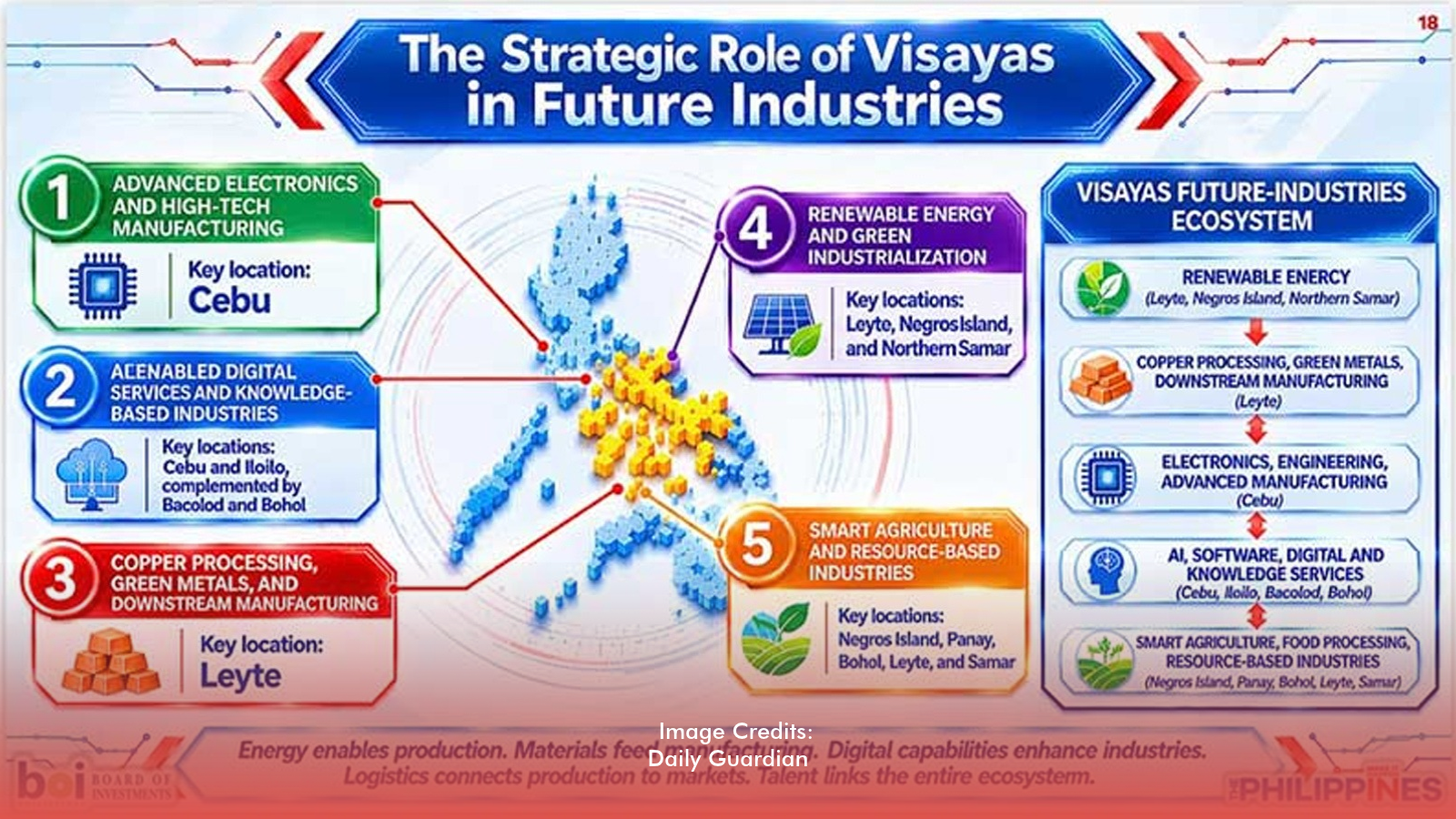
The Board of Investments (BOI) is looking to transform the Visayas into an interconnected industrial hub for artificial intelligence (AI), advanced manufacturing, renewable energy, and technology-enabled services.
Sandra Marie Recolizado, director of the BOI Investment Policy and Planning Service, said the region has the resources, skilled workforce, manufacturing capabilities, and digital infrastructure needed to attract more high-value investments.
She said the focus is to connect the strengths of different provinces and move beyond raw material extraction and basic processing toward advanced industries that can create more jobs and strengthen local supply chains.
Five Industries Identified for Growth
The proposed transformation is part of the BOI's 2026 Strategic Investment Priority Plan (SIPP), which sets the country's investment priorities for 2026 to 2028.
The plan identifies five key industries for the Visayas: advanced electronics and high-tech manufacturing, AI-enabled digital services, copper processing and green metals, renewable energy, and smart agriculture.
Approved by President Ferdinand Marcos Jr. on May 21 through Memorandum Order No. 47, the SIPP identifies projects that may qualify for incentives under the CREATE MORE framework.
Cebu, Iloilo, and Leyte to Drive Industrial Development
Recolizado identified Cebu as the region's main electronics and manufacturing center, while Cebu and Iloilo continue to anchor its digital economy through IT-BPM, software, and analytics services.
Bacolod's growing IT-BPM sector and Bohol's emerging digital services industry also contribute to the region's technology capabilities.
Leyte, meanwhile, could support copper processing and downstream manufacturing through the Philippine Associated Smelting and Refining Corp. (PASAR). The BOI is assisting efforts to reopen the facility, whose operations have been under maintenance since 2025.
Renewable Energy and Smart Agriculture in Focus
Leyte, Negros Island, and Northern Samar were also identified as potential renewable energy centers, particularly for geothermal and biomass projects.
Negros could tap agricultural waste for biomass energy, while Negros, Panay, Bohol, Leyte, and Samar could modernize their agriculture and fisheries industries through automation, precision farming, and AI-based resource management.
Recolizado said these improvements could help local producers meet export requirements and strengthen their access to wider markets.
She emphasized that connecting the capabilities of each province would help establish the Visayas as an integrated industrial ecosystem, requiring cooperation among government agencies, businesses, investors, and international partners.