
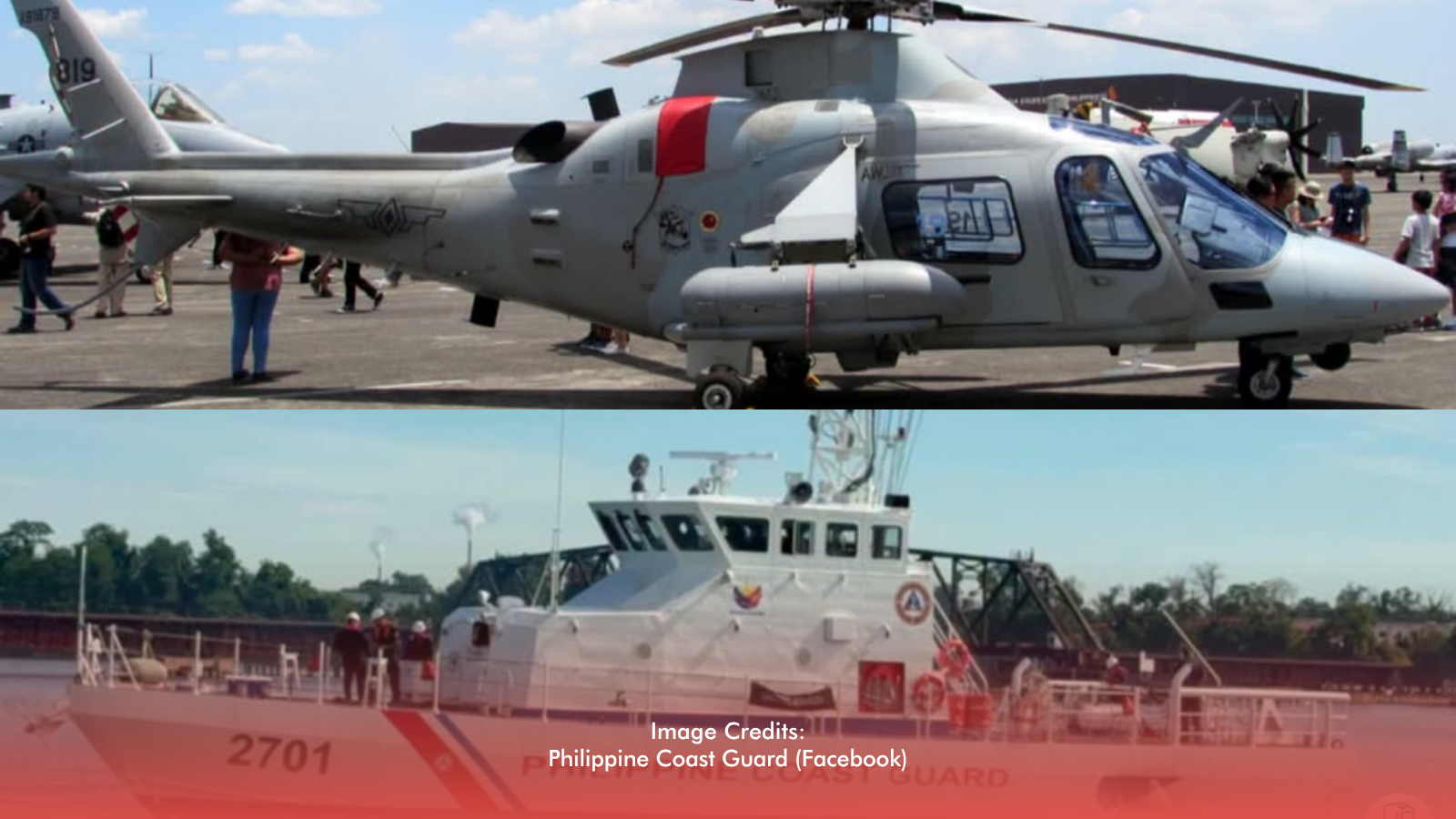
The Philippine Coast Guard (PCG) is preparing to add more aircraft to its fleet as two AgustaWestland AW109E Power helicopters from the Philippine Air Force undergo preparations for transfer, strengthening the agency’s ability to respond to emergencies across Philippine waters.
The two helicopters have already been painted in the PCG’s livery and are being readied for their formal handover. At the same time, PCG pilots and ground crew are undergoing training ahead of the transfer, with additional AW109E units expected to follow in the coming months.
RELATED: [Iloilo Hosts First-Ever Visayas Interagency Territorial Defense Exercise]
New Helicopters to Broaden PCG Response
Once incorporated into the Coast Guard fleet, the aircraft are expected to support a range of operations, from maritime patrols and search-and-rescue missions to disaster response and medical evacuation. The AW109E Power is a twin-engine, multirole helicopter that can also be used for surveillance, transport, search and rescue, and emergency response.
The incoming aircraft will also expand the PCG’s relatively limited helicopter capability. The agency currently has only two Airbus H145 helicopters after retiring its fleet of MBB Bo-105 helicopters.
The additional aerial assets come as the PCG takes on wider responsibilities involving maritime law enforcement, environmental protection, humanitarian assistance and emergency response. More AW109E units are likewise expected to be transferred to the agency.
Air and Sea Assets Set to Strengthen Coast Guard
The PCG’s fleet expansion is not limited to helicopters. Training and the turnover of two Marine Protector-class patrol boats are scheduled for Aug. 20 in Baltimore, Maryland.
The vessels are former United States Coast Guard cutters USCGC Marlin and USCGC Bluefin. Following their transfer to the Philippines, they are expected to enter PCG service as BRP Pag-asa (2701) and BRP Patag (2702), respectively.
Together, the planned aircraft and patrol boat additions will give the Coast Guard more resources to cover the country’s vast maritime territory and respond to incidents at sea. For ordinary Filipinos, stronger search-and-rescue and disaster-response capabilities can mean faster assistance for passengers, fishermen and coastal communities during emergencies, while expanded maritime assets can also help the country better protect its waters and enforce maritime laws.
RELATED: [National Defense Drone Act Filed To Strengthen AFP Operations]