
In 1906, American teacher Fletcher Gardner recorded a few lines about a creature locals in Mindoro called the kapre. He described it as “another monster, but a benign one,” adding that it was “gigantic in size” and “perfectly black.”
That was about all his informants could tell him. There was no mention of a tree or cigar.
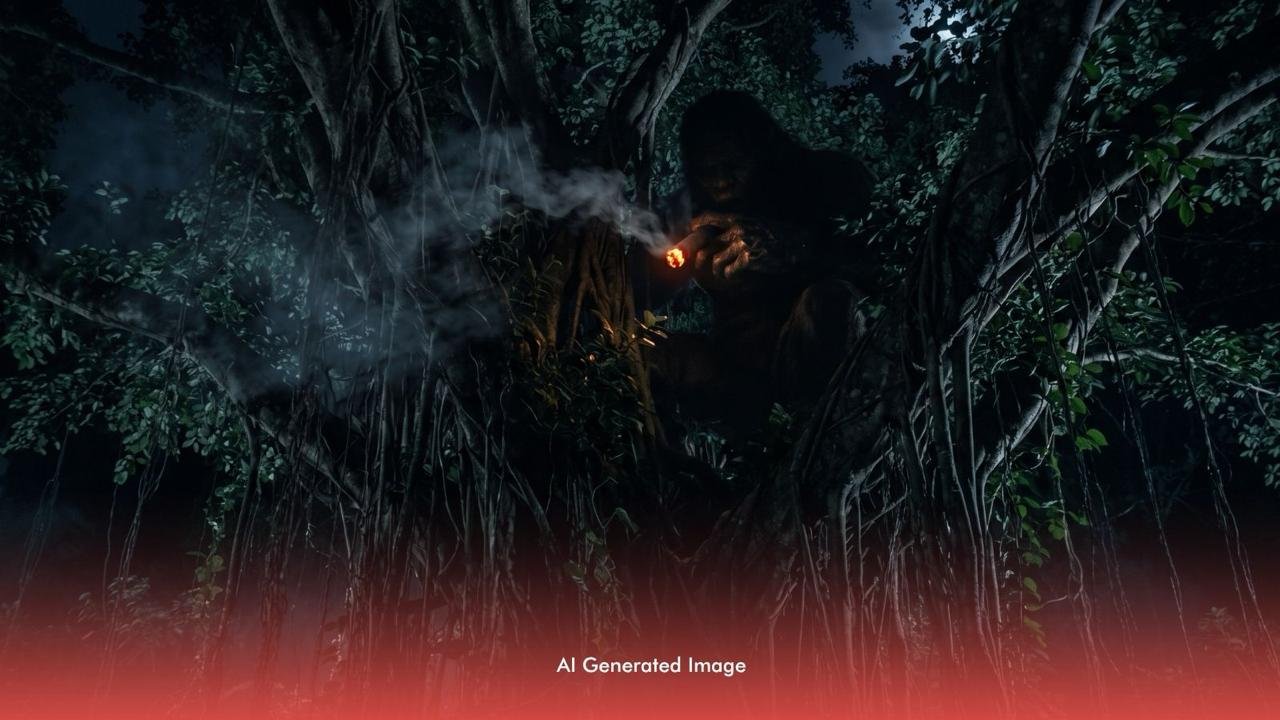
Today, however, the kapre is one of the most familiar figures in Philippine folklore: a huge, hairy giant sitting in a balete or acacia tree after dark, usually smoking a cigar.
What Is a Kapre?
The kapre is a giant in Philippine lower mythology, the folk belief surrounding supernatural beings that share the world with humans.
It is usually described as a tall, dark, and hairy male figure who lives in large trees. Some accounts put it at seven to nine feet tall, while others make it much bigger.
Folklorist Maximo Ramos recorded a Zambales kapre that could shrink to a small figure or grow as tall as a church tower, with eyes as large as plates.
The kapre is often invisible. Instead, people notice signs of its presence: tobacco smoke where nobody is smoking, ash falling from the branches, laughter from nowhere or the feeling of being watched.
And despite its frightening appearance, not every story makes the kapre dangerous. Some tales describe tree giants helping travelers, warning people of danger or lending them a light from their cigar.
Where Does the Kapre Live?
The kapre is most often associated with large, old trees, especially the balete, or strangler fig. Acacia and mango trees also appear in stories.
In 1955, painter Carlos “Botong” Francisco placed the creature in “lightning-scarred acacia or fruitless mango.”
But there is no single version of the kapre across the Philippines. Different regions have their own giant or tree-dwelling beings, including the Ilokano pugot and Eastern Visayan agta.
A 1972 Cebuano dictionary by John Wolff even lists kapri as referring to agtà, a dark supernatural man of extraordinary size who lives in trees, cliffs or abandoned houses.
Interestingly, pugot did not mean a monster everywhere. In a 1921 collection, folklorist Dean Fansler noted that among Tagalogs, Bicolanos, and Visayans, the word could simply refer to someone who was bald or had a shaved head. Its monster meaning was particularly associated with northern traditions.
Is the Kapre Dangerous?
Usually, the kapre is more of a trickster and territorial neighbor than a monster looking for victims.
Its favorite trick is getting people lost. A person walking through a familiar area might suddenly find themselves going in circles or returning to the same spot.
Anthropologist F. Landa Jocano described the kapre as relatively passive but said it could become unforgiving when disturbed, especially when someone harmed or cut down its tree.
This is also where tabi po comes in. The phrase reflects the belief that certain trees and natural spaces may be inhabited by unseen beings. Saying tabi po, or “excuse me,” is a respectful request to pass.
Where Did the Word “Kapre” Come From?
The word kapre is generally traced to the Arabic k?fir, meaning “unbeliever,” through the Portuguese and Spanish cafre.
During the colonial period, cafre acquired racial meanings and was used for Africans and other dark-skinned people. By the late 1800s, however, the word had become attached to supernatural beings in Philippine folklore.
Austrian scholar Ferdinand Blumentritt recorded that farmers in Tayabas, now Quezon, used cafre for a man-eating goblin that supposedly did not like salt. He also noted that Spaniards in Ilocos used the word for the pugot.
The salt detail is interesting because some engkanto traditions also describe supernatural food as being prepared without salt, showing how details could overlap between different folk traditions.
Why Does the Kapre Smoke a Cigar?
The cigar may be connected to another regional creature.
In 1921, Fansler described the pugot of Ilokano and Kapampangan folklore as a shape-shifter that could appear as a cat, a huge dog, or an enormous dark man smoking a large cigar. It lived in large trees or abandoned houses and could disappear as a ball of fire.
Fansler connected the creature to the Tagalog cafre. Some folklorists believe that details such as the cigar eventually became part of the wider image of the kapre as regional traditions blended through books, comics, and other media.
There is no definitive proof, but the similarities are hard to miss.
A Few Kapre Legends
One memorable story is Suac and the Pugut, a Kapampangan tale from Arayat.
Three hunters cook a wild hog beneath a giant tree when a huge, bearded figure climbs down and eats their food. When it returns, young Suac fights back, eventually tricking the giant into a pit and pushing it toward a crocodile.
Other stories are less dramatic. Ramos recorded a Zambales kapre capable of growing as tall as a church tower, while other tales tell of travelers receiving a light from a tree giant after greeting it politely.
What Do Old Folks Say to Do?
The traditional advice is less about fighting the kapre and more about showing respect.
- Say tabi po. Greet large, old trees before passing, especially after dark.
- Turn your shirt inside out. In some folk beliefs, this can help if you become lost or keep returning to the same place.
- Ask before cutting a tree. Old traditions warn against disturbing a tree believed to be a spirit’s home without permission or ritual.
- Leave offerings alone. Cigars, candles or food near a tree may have been placed there intentionally.
- A 2013 study of Philippine supernatural narratives noted that creatures such as the kapre and duwende have become less prominent in stories told in cities. Still, their names and images remain familiar through books, films, television and the internet.
In 1906, Gardner’s informants could only tell him that the kapre was enormous and dark.
More than a century later, it has gained a tree, a cigar and a permanent place in Philippine folklore.
So if you ever pass a mysterious old tree after dark, you know what to say:
Tabi-tabi po.