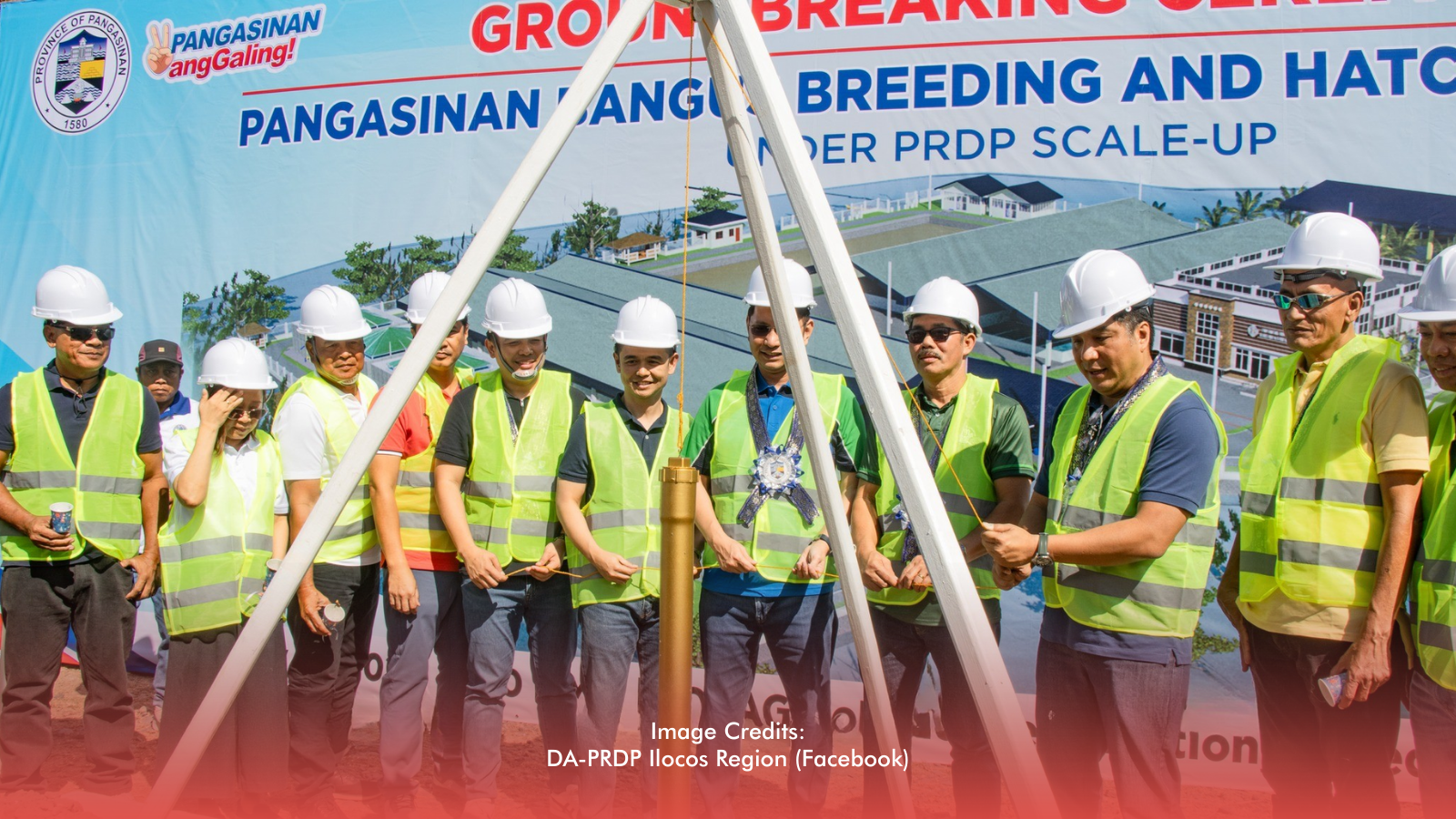
Pangasinan has taken a historic step in advancing the country’s milkfish industry with the groundbreaking of the first local government unit (LGU)-led bangus breeding and hatchery facility. The project, unveiled on January 31 in Barangay Arnedo, Bolinao, aims to provide a steady supply of high-quality bangus fry and support over 40,000 fisherfolk in the Ilocos Region.
RELATED: [Iloilo Records Global First In Captive Spawning Of Mackerel Tuna]
Milestone for Sustainable Aquaculture
The P238.9-million Pangasinan Bangus Breeding and Hatchery Project is funded under the Philippine Rural Development Project (PRDP) Scale-Up, with additional support from the World Bank. Of the total investment, P191 million comes from PRDP loan proceeds, while the Department of Agriculture (DA) and the Provincial Government of Pangasinan each contributed around P23 million. Once operational, the hatchery is expected to produce over 100 million fry and 48,000 larvae annually.
“This project marks a very important milestone. It is a strategic response to the limited supply of bangus fry, and it was made possible through strong leadership and close partnership among government agencies,” DA Regional Field Office 1 Executive Director Fidel Libao said, representing Agriculture Secretary Francisco Tiu Laurel Jr.
The facility seeks to reduce reliance on wild-caught and imported fry, while fostering sustainable aquaculture practices. PRDP Scale-Up Ilocos director Fidel Libao emphasized the broader benefits of the initiative, noting that it “greatly help[s] our fisherfolk produce quality bangus and improve their productivity and income.”
Local Impact and Opportunities
Governor Ramon V. Guico III highlighted that the project will empower fishers by ensuring a consistent and high-quality supply of fry, lowering production costs, and enhancing the province’s fisheries infrastructure. “This project seeks to provide an adequate, continuous and quality supply of bangus fry through Pangasinan’s own breeding and hatchery facilities,” Guico said. “This will strengthen the fisheries industry, reduce production expenses, and lessen dependence on imported fry.”
The hatchery is set to directly benefit 17 municipalities, including Dagupan City, and 63 nursery operators, along with a satellite facility in Pangasinan. Miguel Xavier Ramirez, a fisheries student at Pangasinan State University-Binmaley, noted, “The facility could also benefit BSFAS students like me, particularly for thesis work and practical testing.”
After four years of technical reviews and bidding, the province now has the infrastructure to meet about 30 percent of its annual fry requirement, narrowing a longstanding supply gap. The facility is projected to produce 148.8 million bangus fry annually, with a capacity of 100.78 million fry and 48.05 million larvae.
This initiative strengthens Pangasinan’s standing as the “Bangus Capital of the Philippines,” promoting innovation and self-reliance in the local aquaculture sector. Beyond fisheries, the hatchery is expected to improve livelihoods, create jobs, and stimulate economic activity in Bolinao and neighboring communities, demonstrating how LGU-led projects can drive sustainable development at the local and national level.
RELATED: [P3.6-B Mega Food Hub In Clark To Modernize Agri-Logistics]