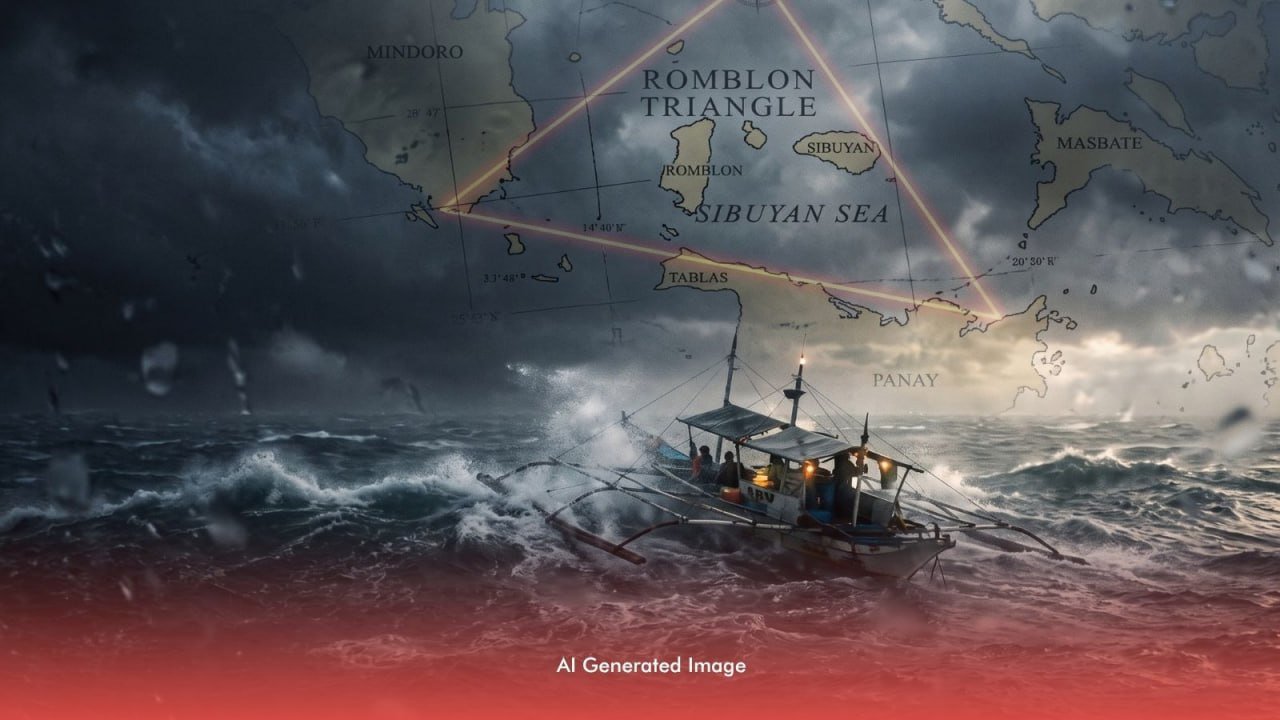
Search for the Philippines’ strangest places, and the Romblon Triangle will eventually appear. It is often described as a dangerous stretch of sea where ships mysteriously disappear, earning it comparisons to the Bermuda Triangle.
The disasters are real. The deaths are real. But the triangle itself is harder to define.
Based on available records, the “Romblon Triangle” appears to be a relatively recent label attached to several real maritime tragedies, along with local stories about supernatural ships and spirits. Unlike older Philippine legends, there is little evidence of a long-standing folk tradition surrounding the triangle itself.
What Is the Romblon Triangle?
Romblon is an island province in the central Philippines. Its three major islands, Tablas, Romblon, and Sibuyan, sit around the Tablas Strait and Sibuyan Sea, along important routes connecting Manila and the Visayas.
There is no single agreed-upon boundary for the so-called triangle.
Some versions place its points around Concepcion on Sibale, or Maestre de Campo Island, the Dos Hermanas islets, and Sibuyan Island. Others stretch the area farther across the Tablas Strait and Sibuyan Sea.
Even the shape depends on who is drawing it.
Where Did the Name Come From?
Local and online accounts credit writer and researcher Alden Alag with using the term “Romblon Triangle.” However, his original article and the exact date when he coined the phrase could not be independently located.
The term was already appearing on blogs by around 2012 and in online listicles by 2014. It was later promoted as the “Bermuda Triangle of the Philippines.”
A Romblon mayor was also quoted by a Manila newspaper in 2014 saying that many ships had made the area their “final resting place.”
But there is an important distinction: no folklore collection or academic study reviewed for this story treats the “Romblon Triangle” as an old traditional belief.
The name appears to be modern. The tragedies it references are not.
Which Shipwrecks Are Linked to the Triangle?
Several major maritime disasters are regularly included in online lists.
The most notorious is the MV Doña Paz, which collided with the tanker MT Vector on Dec. 20, 1987, near Dumali Point in the Tablas Strait. The tanker caught fire, and the overcrowded ferry sank. A later government task force estimated that more than 4,300 people were aboard, with only about two dozen survivors. The disaster is widely considered the deadliest peacetime maritime disaster in history.
Another was the MV Don Juan, which collided with the tanker MT Tacloban City in the Tablas Strait on April 22, 1980. The Supreme Court later found that the passenger ship was carrying 1,004 people, about 140 above its allowed capacity. The commonly cited death toll is 176.
Then came the MV Princess of the Stars. The Sulpicio Lines ferry left Manila for Cebu on June 21, 2008, as Typhoon Frank approached. After the storm changed course, the ship capsized off San Fernando, Sibuyan. The final official toll listed 814 dead and missing, with 56 survivors.
The vessel was also carrying the pesticide endosulfan. After the sinking, fishermen in San Fernando stopped fishing because of fears about contamination, leaving many families dependent on relief goods while salvage operations were carried out.
The area also holds the wreck of Japanese battleship Musashi, one of the largest battleships ever built. American aircraft sank it in the Sibuyan Sea during the Battle of Leyte Gulf on Oct. 24, 1944. More than 1,000 crew members died. The wreck was discovered in 2015.
Online lists often mix dates, locations, and casualty figures, and some claims of dozens of other unexplained disasters have no traceable source.
Why Are Romblon’s Waters Dangerous?
The waters around Romblon are busy and naturally challenging.
The province sits where several major sea routes converge, including passages between Manila and the Visayas. Strong currents, changing sea conditions, and the province’s location within the typhoon belt can make crossings hazardous.
But human decisions have also played a major role in some of the biggest disasters.
The Doña Paz was severely overcrowded, while the tanker involved was later found to have serious problems. The Don Juan was overloaded. The Princess of the Stars sailed despite a typhoon threat.
Coast Guard officials have pointed to storms, high tides, human error, disorientation and underwater geography as factors that can make the area dangerous.
That makes the Bermuda Triangle comparison misleading.
There is no established evidence that ships or aircraft mysteriously disappear around Romblon at unusually high rates. Unlike supernatural accounts, these major disasters have documented wrecks, survivors, investigations and identifiable contributing factors.
Who Is Lolo Amang?
Romblon does, however, have its own maritime folklore.
One of the best-known stories involves Lolo Amang and his golden ship, a phantom vessel said to appear to fishermen before a disaster.
According to local retellings, the golden ship can be seen on the horizon before disappearing when the sea becomes dark. One unverified version claims that a Don Juan survivor said the ship swerved to avoid a mysterious vessel before colliding with the tanker.
Sibuyan also has stories of a Tinagong Dagat, or hidden sea, supposedly located inside Mount Guiting-Guiting. In the legend, engkanto are said to have ships that enter the mountain through an invisible passage from the sea.
These stories have much deeper roots in local folklore than the “Romblon Triangle” label itself.
Is Romblon a “Witch Island”?
Some online posts describe Romblon as a “witch island” similar to Siquijor, but there is little reliable evidence supporting the comparison.
Romblon does have supernatural traditions. Stories mention the kagkag, creatures said to emerge around moonrise and moonset to seek the newly buried, as well as the engkanto associated with Sibuyan’s mountains.
But that is different from Siquijor’s well-documented reputation for traditional healers and folk magic.
Legends of Romblon’s Waters
- The Golden Ship: Lolo Amang’s mysterious golden vessel reportedly appears before disasters.
- The Swerve: One unverified story claims the Don Juan changed course to avoid a ship that other people could not see.
- The Hidden Sea: A secret body of water inside Mount Guiting-Guiting is said to be where engkanto dock their ships.
- The Cloud: One Sibuyan legend says clouds once covered the entire island, hiding it from a Japanese ship attempting to land.
Before You Go
If you are traveling through Romblon, treat the real dangers more seriously than the supernatural ones.
Check Coast Guard advisories before crossing, especially during typhoon season. Know where the life jackets are and avoid visibly overloaded vessels.
And remember that famous wrecks such as the Musashi are not simply tourist attractions. They are war graves and protected historical sites.
The Romblon Triangle may make for a compelling mystery, but the evidence tells a more grounded story.
The waters are dangerous because of storms, currents, heavy maritime traffic, and, at times, human error.
The ghosts and golden ships belong to folklore.
The wrecks belong to history.