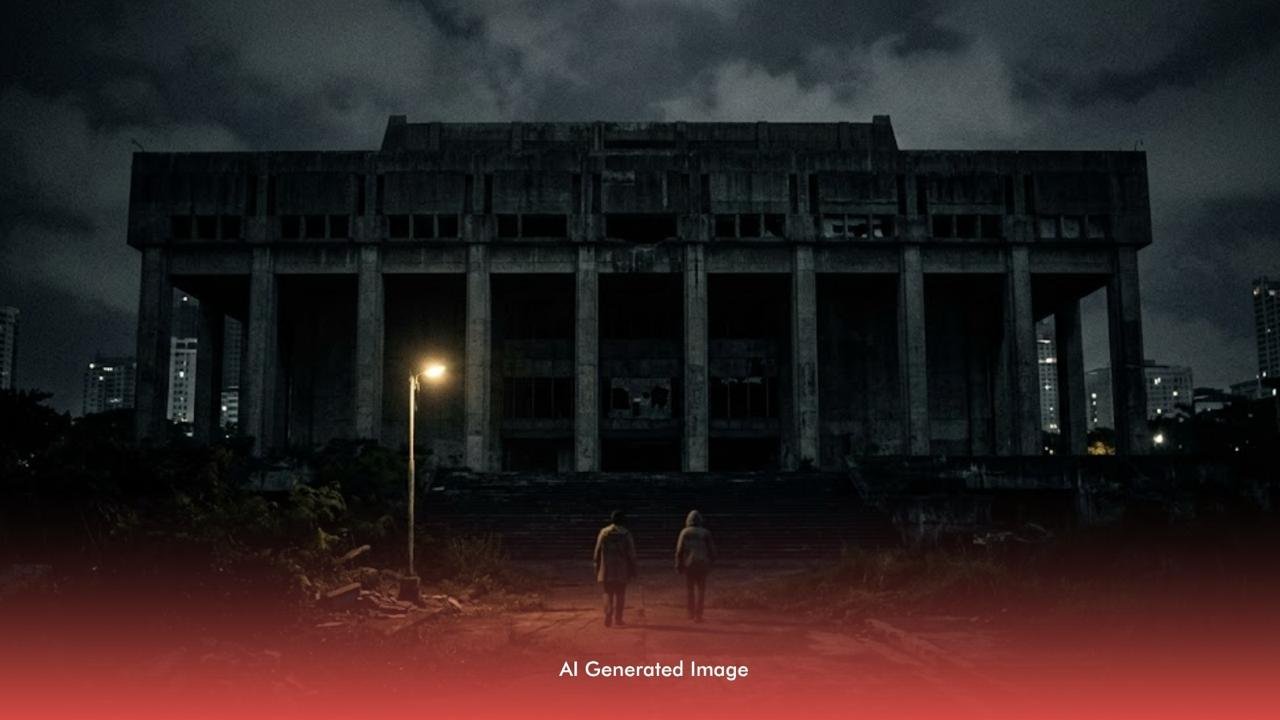
At the southwest edge of the Cultural Center of the Philippines Complex in Pasay stands the Manila Film Center, a massive concrete building with a colonnade inspired by the Parthenon. Facing Manila Bay across reclaimed land, it has been largely unused for decades.
It is also one of the Philippines’ most famous haunted buildings.
The stories trace back to a real tragedy. In November 1981, part of the building collapsed during construction, killing workers on the night shift. Exactly how many died remains disputed.
That uncertainty, combined with secrecy surrounding the accident and decades of ghost stories, helped turn the Film Center into one of the country’s most enduring urban legends.
Why Was the Manila Film Center Built?
In 1981, First Lady Imelda Marcos wanted Manila to host an international film festival that could rival major events such as Cannes. The Manila Film Center was built to house the festival and serve as a national film archive, with UNESCO consultants involved in designing its archive floors.
Architect Froilan Hong designed the building, which stands on more than 900 piles driven into bedrock beneath the reclaimed land.
The biggest challenge was the deadline.
The festival was scheduled for Jan. 18, 1982, giving builders roughly 170 days to finish the structure. Thousands of laborers worked around the clock in three shifts. One account said about 1,000 workers completed the lobby in 72 hours, a job that would normally take six weeks.
The rush became part of the building’s history. Architectural historian Gerard Lico has written about the Marcos-era “edifice complex,” describing it as “an obsession and compulsion to build edifices as a hallmark of greatness.”
What Happened on Nov. 17, 1981?
In the early hours of Nov. 17, 1981, part of the structure above the main theater collapsed while workers were pouring concrete.
Scaffolding, wet concrete, steel and timber came crashing down on the night shift.
A survivor later said he had warned that the roof could not safely be covered in a single pour. Another worker recalled that a different section had collapsed a week earlier, although no one was injured. A carpenter described hearing “a roar that sounded like thunder.”
The press was kept away from the site. According to United Press International, the government issued its first statement only after a 15-hour news blackout, saying three people had died.
A public works minister described the collapse as a “normal construction hazard.”
Television footage from the day showed rescuers digging out a worker who had been trapped in cement from the waist down for more than 10 hours. He was already dead when they freed him.
How Many Workers Died?
There is no single figure accepted by everyone.
The government initially reported three deaths, later revising the official figure to seven. Years afterward, architect Froilan Hong reportedly gave the same number to a former CCP president and said all seven bodies had been recovered and given proper rites.
Workers at the site gave a different account. They told reporters that 26 bodies had been pulled from the debris that week. By January, they reportedly put the number at 28.
Then there is the figure most commonly repeated online: 169.
That number does not come from an official death record. The earliest printed source identified for it is a 1997 magazine report about the Spirit Questors, a group of psychics who claimed during séances that 169 workers had been left inside the building.
So one of the most famous “facts” surrounding the Film Center actually originated from a séance.
Two additional workers died in separate falls in January 1982, shortly before the opening.
Imelda Marcos denied reports that 26 workers had died and called the accounts exaggerated. She also maintained that she knew nothing about bodies being left inside the building.
A 2005 documentary found no accident report at the Pasay police station or the Cultural Center of the Philippines. The contractor interviewed for the documentary said “not even a fingernail” was left in the concrete.
The record therefore supports a few points: workers died, the official accounting was disputed, and martial-law-era restrictions made an independent accounting difficult.
What Happened After the Building Opened?
Despite the tragedy, the Manila Film Center opened on schedule on Jan. 18, 1982, for the first Manila International Film Festival.
Foreign stars walked its red carpet, while former staff later recalled that some cement beneath the carpet was still damp.
The festival also gave the building a place in Philippine film history. India’s 36 Chowringhee Lane won Best Picture at the first Manila International Film Festival.
Days after the opening, the Experimental Cinema of the Philippines was created and operated from the Film Center, with Imee Marcos as its first head.
The government film agency produced and supported important Filipino films, including Peque Gallaga’s Oro, Plata, Mata and Ishmael Bernal’s Himala, which became one of the country’s most celebrated films.
The festival itself lasted only two editions. The Experimental Cinema of the Philippines was abolished in 1985.
After the 1986 People Power Revolution, staff left the building. The July 1990 Luzon earthquake later damaged its load-bearing beams, and the Film Center was abandoned.
It was rehabilitated in 2001 and later leased to a production company. A fire in 2013 damaged part of the building and ended production.
Why Is the Manila Film Center Considered Haunted?
The ingredients for a ghost story were already there: workers died, information about the accident was restricted, the death toll remained disputed, and the massive building later stood largely empty.
Rituals surrounding the tragedy also became part of the legend.
Former staff have described a Catholic rite, a Chinese rite, animal offerings and, at dawn before the opening, a cañao, a Cordillera ritual held on the steps. Elders reportedly performed the ceremony to tell the spirits of the dead that they were no longer among the living.
In the 1990s, the Spirit Questors conducted midnight séances inside the building and claimed to hear construction noises. The group also claimed to encounter spirits who said their bodies had never received proper funerals.
Other stories soon followed.
One popular legend tells of a stranger who approaches someone outside the Film Center and asks them to call his family. When the call is made, the family allegedly says the man had already died while working at the building.
Another story claims mediums heard hammering from inside during a séance, while others say the spirits of workers still wander the halls.
None of these stories, however, proves that additional workers were buried inside.
Before You Go
The Manila Film Center is government property and does not have regular public access. Do not trespass or rely on unofficial “ghost tour” claims.
The exterior can be viewed from permitted areas of the CCP Complex, although access rules may change.
Most importantly, remember that the story began with real workers who died during construction. The ghost stories may never be proven, but the tragedy itself is part of the historical record.
More than four decades later, the Manila Film Center still stands facing Manila Bay.
The ghosts remain a matter of belief.
The unanswered questions about the workers are history.