
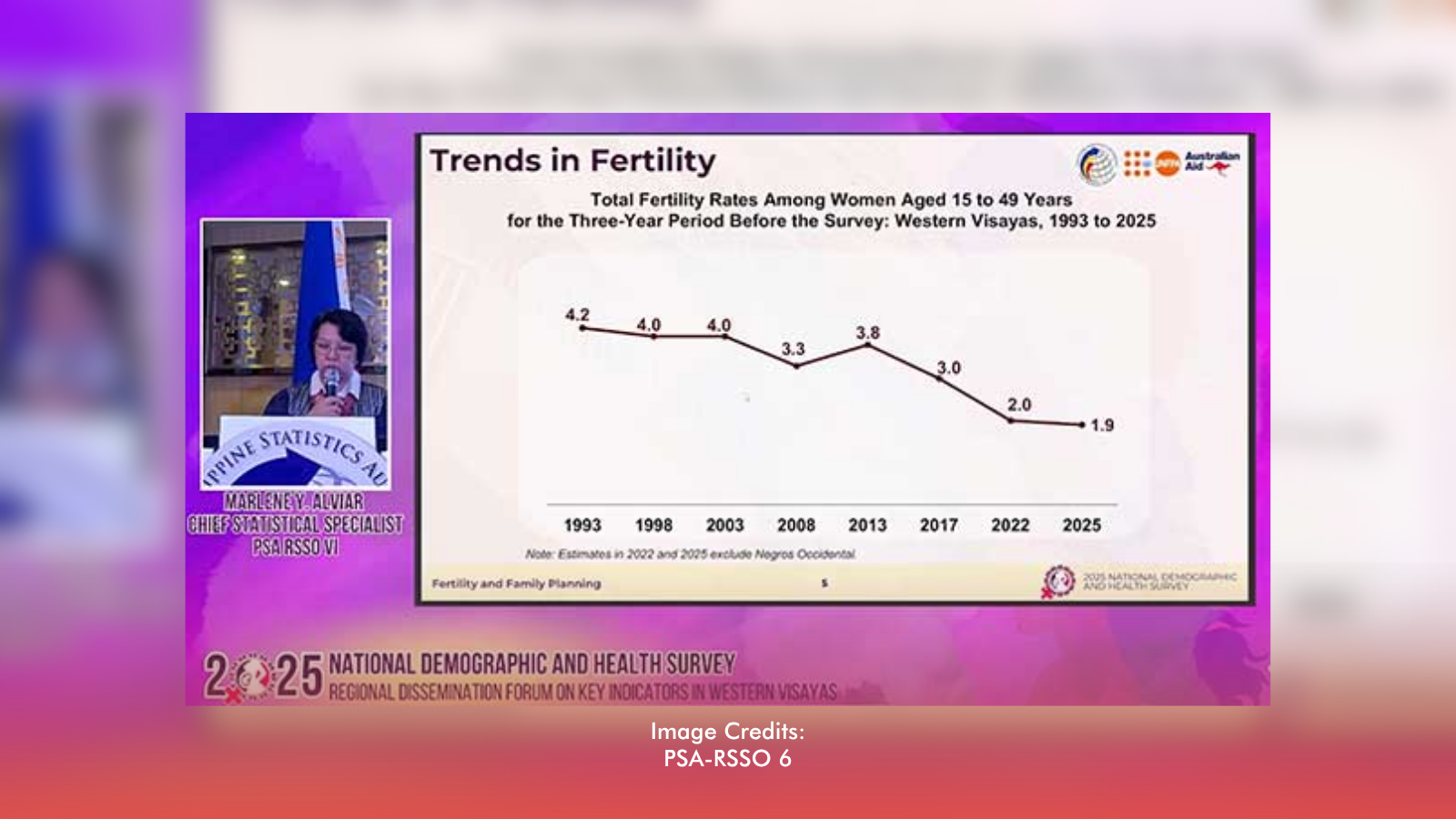
Government demographic data released for 2025 showed that women in Central Visayas are increasingly opting for smaller families, contributing to a continued decline in both fertility and birth rates across the region. According to the Philippine Statistics Authority (PSA), Region 7’s total fertility rate fell to 1.7 children per woman, dropping below the replacement level of 2.1 needed to maintain population growth.
The figures were presented during the dissemination of the 2025 National Demographic and Health Survey. Jessamyn Anne Alcazaren of the Provincial Statistical Office of Bohol noted that the latest data reflects a long-term downward trend from the region’s 4.4 children per woman recorded in 1993.
The PSA explained that the survey evaluated fertility patterns using detailed birth histories of women ages 15 to 49. This included information involving live births, miscarriages, stillbirths, pregnancy terminations, and the status of children whether living with their mothers, living elsewhere, or deceased.
RELATED: [Higher Maternity Benefits Rolled Out To Help Filipino Families During Childbirth]
Smaller Families Become More Common
The agency also analyzed age-specific fertility rates based on births per 1,000 women within various age brackets over the three years before the survey period. Results indicated that nearly half of currently married women in Central Visayas no longer intend to have additional children.
Only a smaller portion of respondents expressed plans to have another child soon or delay pregnancy, while a limited percentage reported sterilization among themselves or their partners.
The decline in fertility was accompanied by lower birth registration numbers throughout the region. Preliminary PSA records showed that Central Visayas logged 60,777 live births from January to October 2025, marking a 16.5 percent decrease compared to the 72,797 births recorded during the same period in 2024.
This mirrored the nationwide trend, with the Philippines posting a 13.9-percent decline in births over the same period. Cebu province, excluding its highly urbanized cities, registered the highest number of births at 30,183. Cebu City followed with 9,357 births, while Lapu-Lapu City recorded 4,891 and Mandaue City posted 3,293.
More male babies were born during the period, totaling 31,774 compared to 29,003 female births.
Economic Pressures and Changing Family Choices
The Commission on Population and Development linked the lower fertility trend to increasing economic pressures, improved access to family planning, and fewer marriage registrations. Marriage numbers in Central Visayas declined significantly, falling from 21,919 in the first 10 months of 2024 to 16,277 in 2025, roughly 26 percent lower.
Teenage pregnancy in the region stood at 3.3 percent among women ages 15 to 49. Meanwhile, 25.7 percent of women within the same age group reported using any contraceptive method, increasing to 47.8 percent among currently married women.
Oral pills remained the most widely used contraceptive method at 10.2 percent, followed by IUDs at 2.8 percent, female sterilization at 2.6 percent, injectables at 2.4 percent, implants at 1.6 percent, and male condoms at 1.3 percent.
Despite this, PSA data also showed an overall decline in contraceptive use compared with previous years. Usage among all women dropped from 36.2 percent in 2022 to 25.7 percent in 2025, while contraceptive use among currently married women declined from 60.8 percent to 47.8 percent.
The survey further revealed that 42.5 percent of women in Central Visayas live in rural communities. In terms of education, 40.8 percent reached some college level, while 49.5 percent completed junior or senior high school. More than half, or 54.2 percent, were married or living with a partner.
For many Filipinos, these demographic shifts reflect changing economic realities and evolving family priorities. Lower fertility and marriage rates may influence future workforce trends, education planning, healthcare needs, and long-term economic development not only in Central Visayas but across the country as well.