
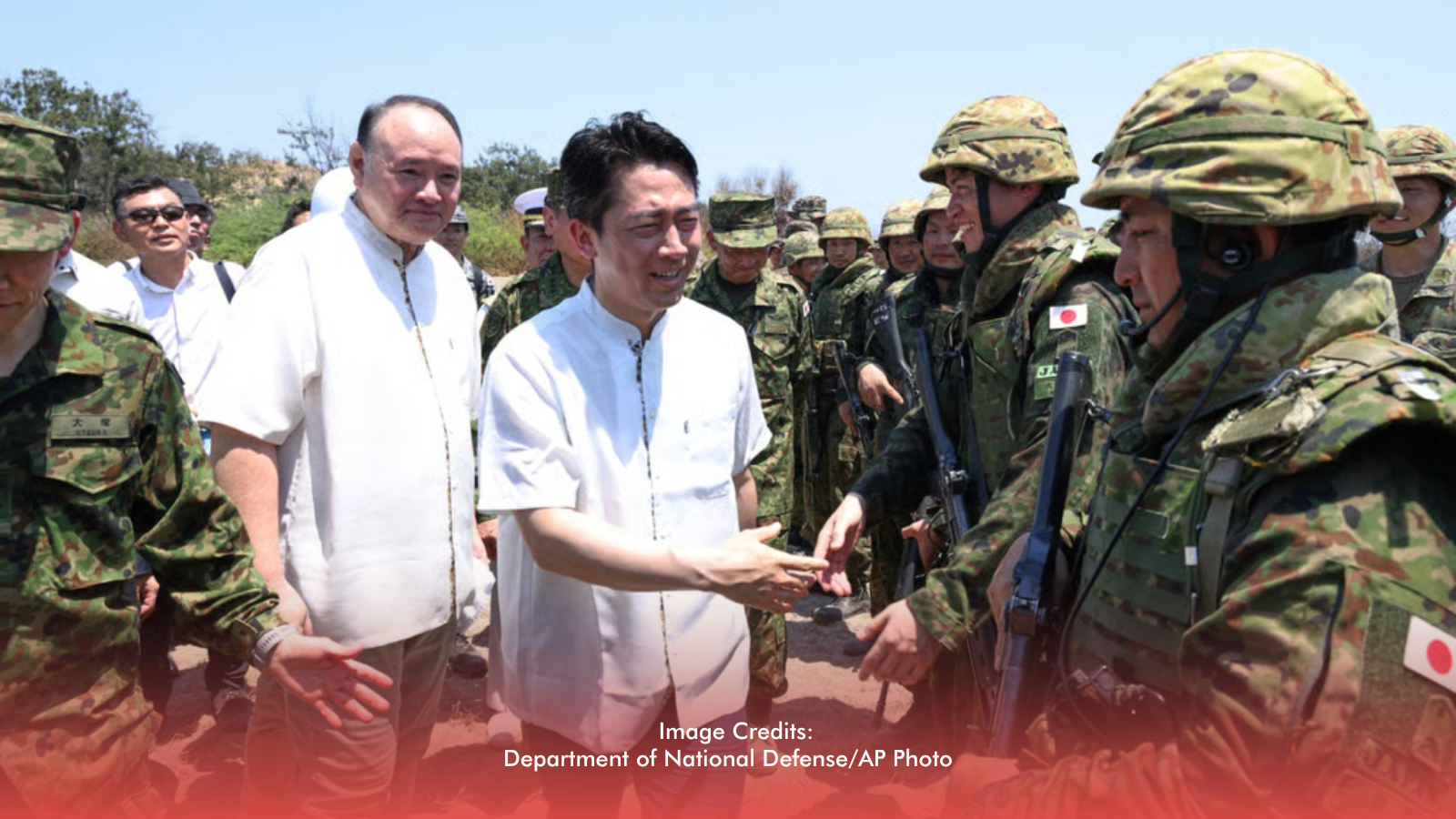
Japan’s decision to deepen its military footprint in the Philippines marks one of the most significant shifts in regional security alignment in recent years. With the permanent stationing of defense attachés across its Army, Navy, and Air Force, alongside missile cooperation, joint exercises like Balikatan, and the Reciprocal Access Agreement, the relationship between Tokyo and Manila is moving far beyond traditional diplomacy. It now sits in the realm of sustained strategic alignment.
RELATED: [PH Set To Acquire Advanced Defense Equipment From Japan]
Strengthening Defense Capabilities and Deterrence
On the surface, the advantages are clear. For the Philippines, closer defense cooperation with Japan strengthens deterrence in an increasingly contested Indo-Pacific. Access to advanced military technology, intelligence sharing, and coordinated training exercises can significantly improve the country’s defensive readiness.
Japan’s involvement also helps professionalize and modernize the Armed Forces of the Philippines, which has long faced capability gaps in maritime surveillance and territorial defense. In this sense, the shift can be seen as a practical response to regional uncertainties, offering Manila a stronger security network without relying solely on a single ally.
Strategic Gains with Emerging Trade-Offs
However, the implications are not entirely straightforward. A deeper level of integration also raises questions about strategic dependency. As the Philippines becomes more embedded in overlapping defense arrangements, its foreign policy space may gradually narrow. Decisions that once rested on independent calculation could increasingly be shaped by alliance expectations and regional power dynamics.
There’s also the broader concern of escalation, greater military presence and coordination may deter conflict, but it may also place the Philippines more firmly within the frontlines of geopolitical tensions in the Indo-Pacific.
Another layer worth considering is whether this shift is purely defensive or part of a longer strategic recalibration by Japan itself. Tokyo’s growing security posture suggests a broader effort to expand its influence beyond its immediate periphery, particularly in response to regional power shifts. The Philippines, by geography and strategic location, naturally becomes a key partner in this expansion.
Ultimately, the question is not whether the partnership is beneficial, it clearly brings immediate security and capacity gains. The deeper question is what it evolves into over time. Is the Philippines strengthening its autonomy through diversified alliances, or slowly becoming a fixed point in a larger security architecture shaped by external powers?
Japan’s military shift is not just about cooperation. It’s about positioning, influence, and the long-term structure of regional power. For the Philippines, it signals both opportunity and complexity, and it demands careful rethinking of what security partnership truly means in a rapidly changing Indo-Pacific.
RELATED: [PH May Host Ammo Production Line Under Indo-Pacific Defense Pact]