The Philippines sits in a strange sweet spot for renewable energy: it has strong sunlight most of the year, consistent wind corridors, rivers suited for hydropower, and, thanks to its location on the Pacific Ring of Fire, more volcanic activity than almost any country. As of December 2025, renewables made up about 32.9% of the country’s installed power capacity, roughly 10,500 megawatts, with the government aiming to push that past 40% by 2030 and over 50% by 2040.
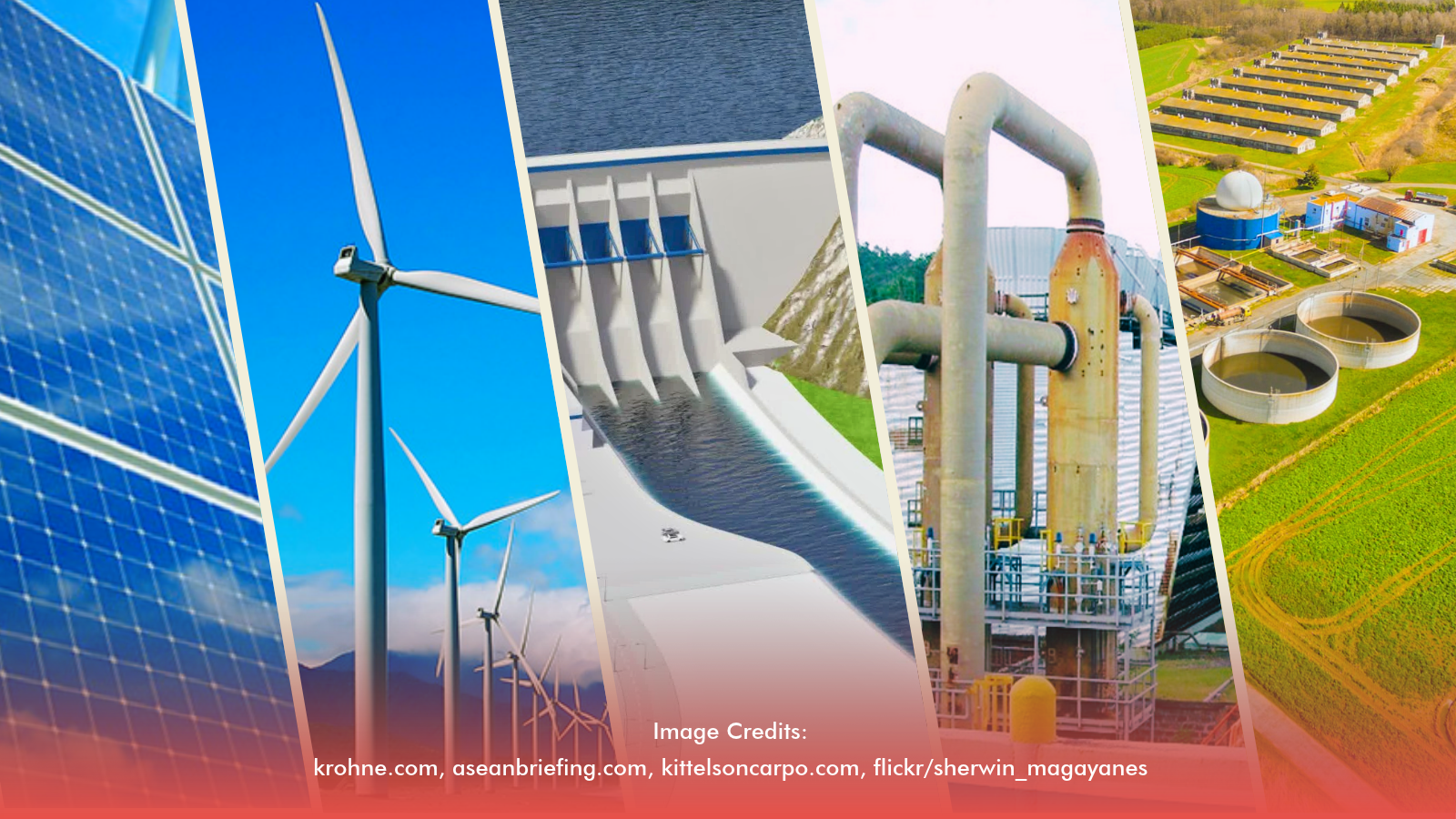
Here’s a look at the five renewable sources doing the heavy lifting.
Solar
Solar power converts sunlight into electricity using photovoltaic panels and inverters, and it performs best in areas with strong, consistent sun exposure, which describes most of the Philippines. Northern and Central Luzon have the country’s highest solar potential, and the majority of the nation’s solar plants are concentrated there.
Beyond utility-scale plants, solar panels have become increasingly common on commercial and industrial rooftops, and a growing number of residential ones too. As of the most recent industry data, solar accounts for roughly 11% of the country’s total installed capacity.
Wind
Wind farms turn moving air into electricity through clusters of turbines, and the Philippines’ strongest wind potential is concentrated in Ilocos Norte, home to several of the country’s existing wind power plants.
Wind remains the smallest renewable contributor today, at under 2% of installed capacity, but that’s set to change: a major offshore wind auction is targeting up to 3,300 megawatts of new fixed-bottom offshore capacity for delivery between 2028 and 2030, alongside onshore projects already in development in Abra-Kalinga, Negros Occidental, and Camarines Sur.
Hydropower
Hydropower remains the country’s leading renewable source, drawing on flowing or falling water to drive turbines. Large dams like Angat in Bulacan, Ambuklao and Binga in Benguet, and Caliraya in Laguna anchor the bigger installations, while smaller run-of-river plants, found mainly in Benguet, Bohol, and the Davao Region, divert part of a waterway’s flow without needing a full reservoir.
Hydropower alone accounts for roughly 12% of the country’s total installed capacity, making it the single biggest renewable piece of the puzzle.
Geothermal
Few countries are as naturally suited to geothermal energy as the Philippines. Sitting on the Pacific Ring of Fire gives the country direct access to underground heat, tapped through hot water or steam reservoirs to generate electricity.
Notable sites include areas near Mayon Volcano in Albay, along an active fault line in Leyte, and on the western slopes of Mount Apo in North Cotabato. Geothermal contributes roughly 8% of total installed capacity, and new projects, including a 30-megawatt development in Sorsogon, are still being built out.
Biomass
Biomass energy burns organic material, such as wood, agricultural residue, or other waste, to generate heat for electricity. Negros Occidental, long known as the “Sugar Bowl of the Philippines,” puts its sugarcane byproducts to use this way, powering plants that turn agricultural waste into electricity rather than letting it go unused.
Biomass remains a smaller slice of the renewable mix, at under 2% of total installed capacity, but it’s a practical example of turning an existing industry’s waste stream into energy.
The country has the natural resources to expand its renewable energy capacity, but turning that potential into a reliable power supply will depend on continued investment, better infrastructure, and long-term planning. As these five sources continue to develop, the Philippines has an opportunity to build a more diverse energy mix and reduce its dependence on fossil fuels.