
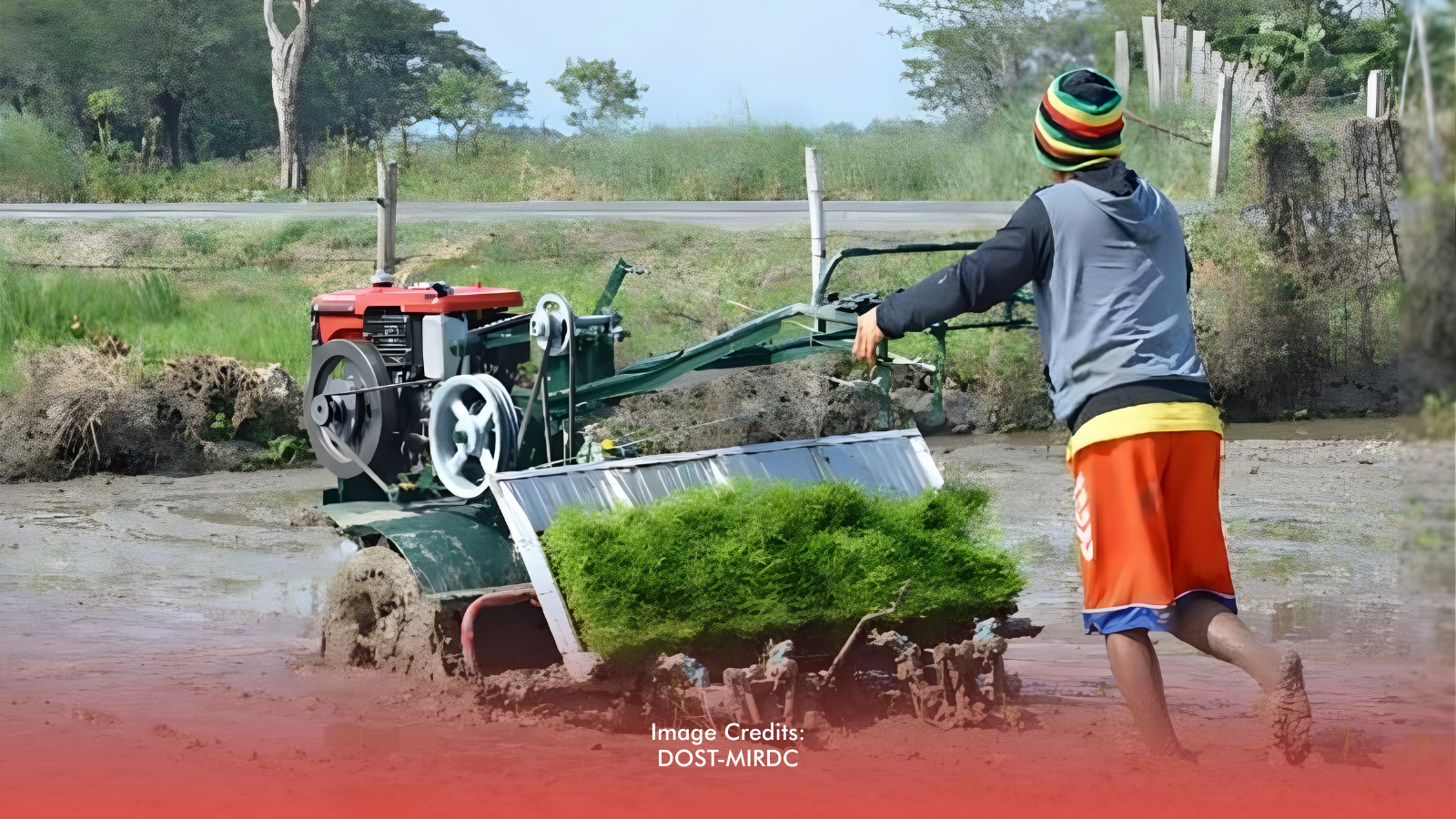
Rice farmers may soon find planting season less labor-intensive with a new mechanization technology developed by the Department of Science and Technology’s Metals Industry Research and Development Center (DOST-MIRDC). The agency is promoting its rice transplanter attachment (RTA), an innovation designed to be fitted onto commonly used hand tractors, allowing farmers to lower labor expenses while improving efficiency in rice production.
The RTA was created in collaboration with the Philippine Center for Postharvest Development and Mechanization to expand the functions of existing farm equipment. Instead of purchasing entirely new machines, farmers can mount the attachment onto hand tractors already used for tilling soil and hauling harvested palay, effectively transforming them into transplanting machines.
From 14 Workers to Just 2
Rey Mariposque, DOST-MIRDC senior science research specialist, explained that the technology enhances the versatility of hand tractors by enabling them to perform another crucial task in rice farming. Through this mechanized approach, the number of workers needed for transplanting is significantly reduced,from 14 workers in manual operations to just two people: an operator and a helper.
“Farmers shared that they previously struggled to source labor and often had to wait for other fields to be planted before workers became available,” Mariposque said. “With the transplanter, only two people are needed—usually the farmer as the operator and a family member to load the seedlings—making planting easier and encouraging younger family members to see that farming is no longer purely manual and physically demanding,” he added.
Field trials conducted in Central Luzon, Calabarzon, and Nueva Vizcaya demonstrated the machine’s capability to transplant up to 1.6 hectares in seven hours of operation. Aside from saving time and labor, farmers who participated in the tests reported at least a 12-percent increase in yield, attributed to more uniform planting in line with Philippine Agricultural Engineering Standards.
Affordable Alternative to Imported Units
Mariposque also pointed out that the RTA offers a more affordable alternative to imported ride-on transplanters. The attachment can be installed on at least 9-horsepower hand tractors and follows International Rice Research Institute design standards.
“Ride-on units in the market cost over P1 million, but our transplanter is priced at less than half a million. With a P1 million budget, a cooperative can buy only one ride-on unit, but they can purchase up to four DOST-developed transplanters, benefiting more farmers,” he said.
Another advantage of the RTA is the use of locally sourced materials, which simplifies fabrication, repair, and maintenance for countryside-based fabricators and farmers. Through its technology transfer program, DOST-MIRDC provides training to licensed fabricators and offers up to 50-percent discount on selected parts manufactured within its facilities.
Farmers and cooperatives interested in adopting the technology may coordinate with their nearest Provincial Science and Technology Office or regional DOST office for guidance on its application. Inquiries may also be sent through the official DOST-MIRDC Facebook page or via email at mirdc@mirdc.dost.gov.ph, with a copy furnished to Director Robert Dizon for proper coordination.
The initiative underscores DOST-MIRDC’s commitment to developing practical and affordable solutions that ease the burden on Filipino farmers. Innovations like the rice transplanter attachment could help stabilize rice production, potentially support lower food costs, and strengthen the country’s food security--benefits that extend from the farm to every household’s dining table.
RELATED: [Cagayan To Establish P275-M Rice Processing Center For Agri Modernization]