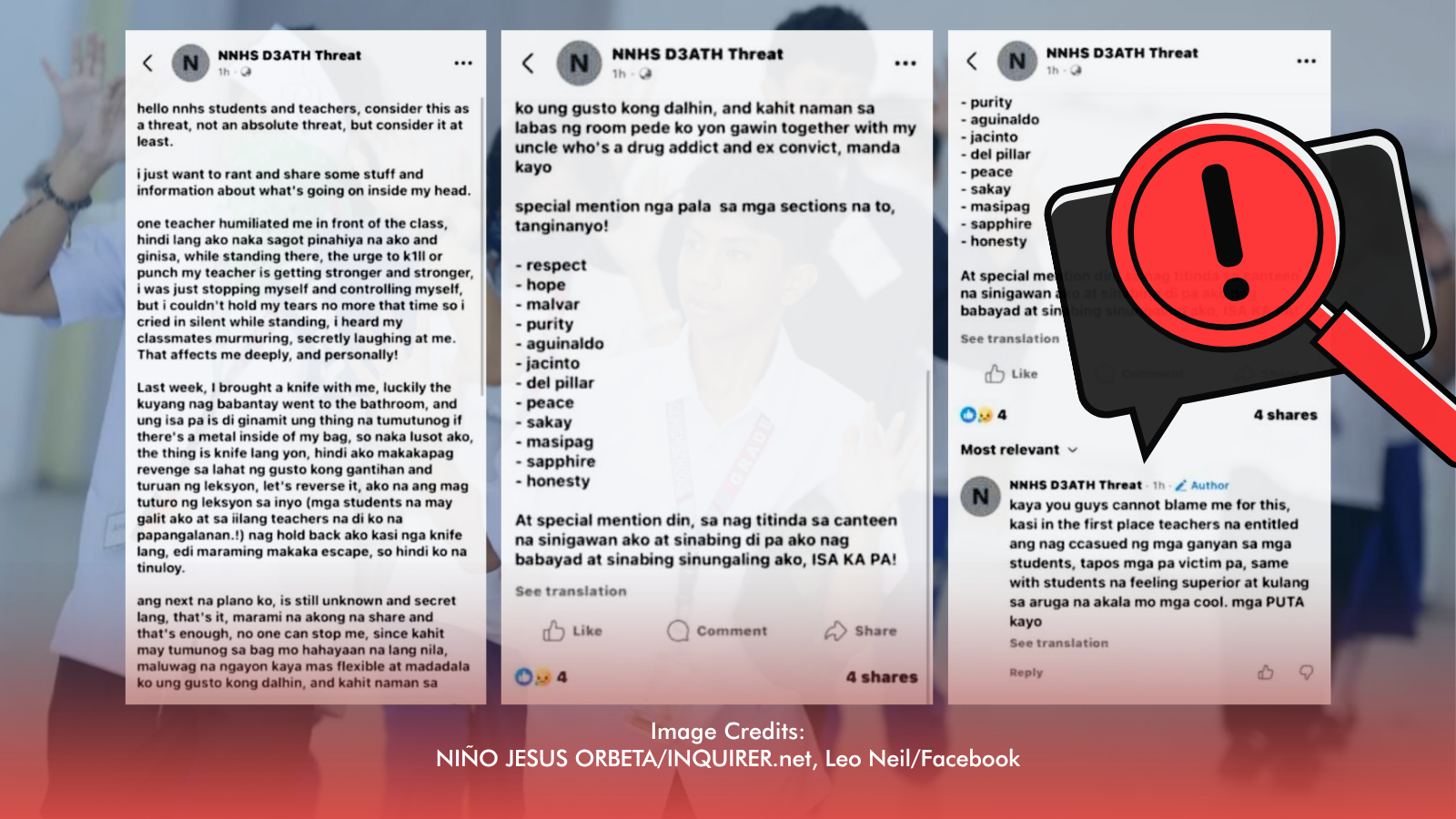
Over the past few weeks, schools across the Philippines have faced a wave of bomb threats, shooting scares, and death threats that have spread rapidly through text messages, anonymous social media accounts, and student group chats.
From Occidental Mindoro to Pampanga, Pasig, Mandaluyong, Cainta, Cavite, Navotas, and other parts of the country, authorities have responded to reports that ultimately turned out to be hoaxes or unverified claims. Even so, each incident has triggered evacuations, class suspensions, and police investigations.
The Philippine National Police (PNP) has acknowledged the increase in school-related threats and urged the public to verify information before sharing it, warning that false reports can create unnecessary panic and strain emergency resources.
Inciting Panic
Unlike natural disasters or technical problems, these incidents often begin with something deceptively simple: a screenshot, an anonymous account, or a message forwarded in a group chat.
Within minutes, rumors spread across campuses. Parents rush to pick up their children. Teachers halt classes. Police officers and bomb disposal teams are deployed to inspect school grounds. Even when no credible threat is found, the disruption is real.
A single false message can interrupt learning for thousands of students while consuming public resources that could have been directed toward genuine emergencies.
When A Joke Becomes A Crime
Some of those responsible claim they were only joking or trying to scare classmates. Under Philippine law, however, false bomb threats are not harmless pranks.
Presidential Decree No. 1727, also known as the Anti-Bomb Joke Law, penalizes individuals who knowingly spread false bomb threats because they endanger public safety and force authorities to mobilize emergency responses unnecessarily. This month, the Department of Education also warned that students who make bomb threats or similar dangerous pranks may face serious disciplinary action, including being barred from re-enrolling in their schools.
The Drawbacks of Technology
What makes today's threats different is how quickly they travel.
Private group chats, disappearing messages, and anonymous accounts allow rumors to spread faster than official announcements. Screenshots are reposted across multiple platforms, making it difficult to distinguish verified information from fabricated claims.
By the time authorities issue clarifications, fear has often already reached thousands of students and parents.
Fear Is The Enemy
The recent wave of threats also raises questions about student behavior in the digital age. Experts have long pointed out that online actions can have real-world consequences. What begins as a post made for attention, entertainment, or retaliation can quickly escalate into police investigations, school closures, and lasting anxiety within communities.
Schools are expected to remain places where students feel safe enough to learn. Preserving that sense of security requires more than police visibility. It also depends on digital responsibility, responsible parenting, and open conversations about the consequences of online behavior.
Authorities will continue investigating those responsible, but preventing future incidents cannot fall on law enforcement alone. Every student, parent, teacher, and social media user has a role in stopping misinformation before it spreads. In an era where a single message can reach thousands within seconds, thinking before posting may be just as important as responding after the fact.
Because sometimes, the greatest damage is not caused by an explosive, but by fear itself.