
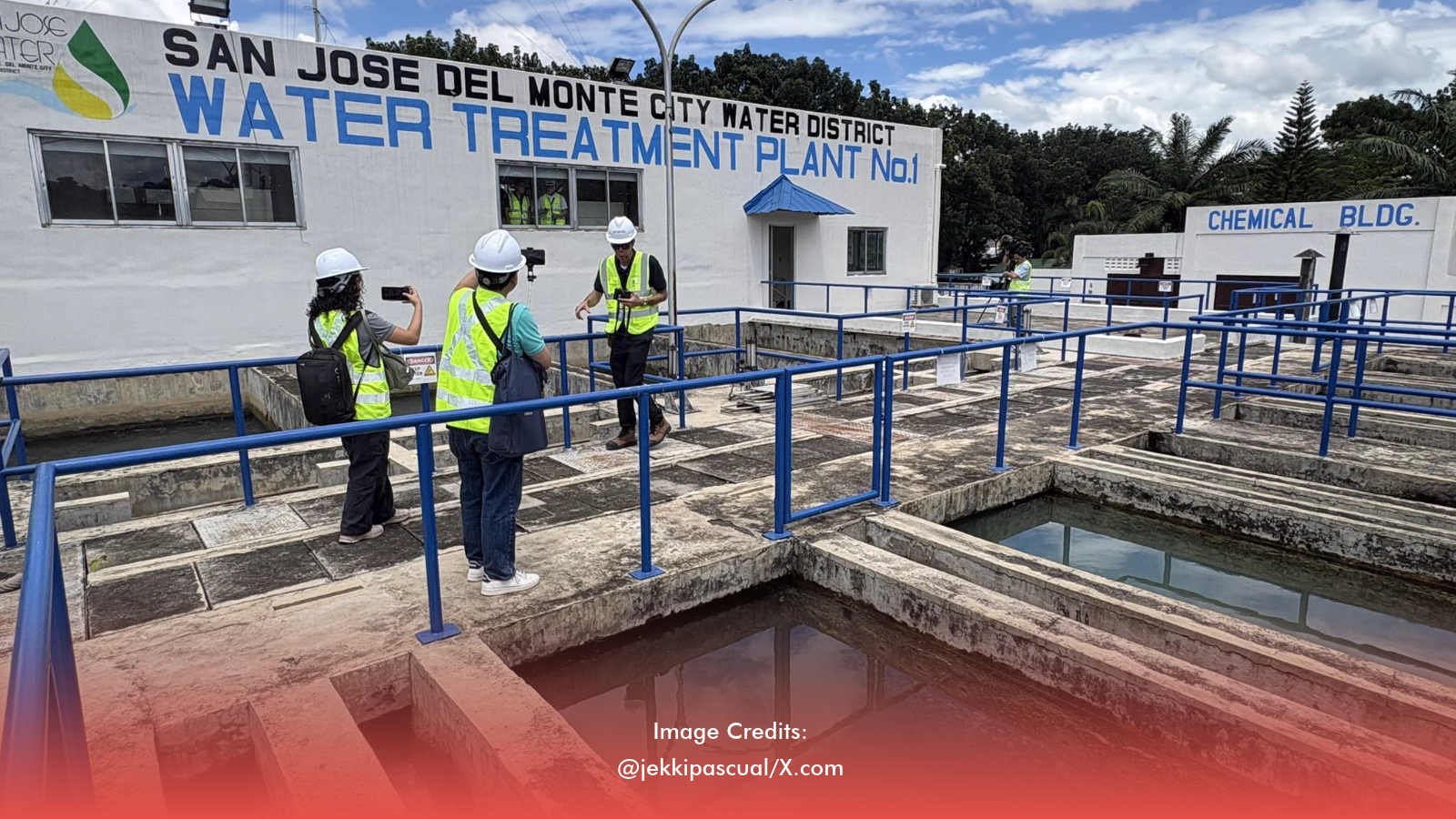
More water is coming out of the taps in San Jose del Monte, Bulacan. The city’s interim water operator is now pumping about 10 percent more than before it took over.
But some households still get low pressure and intermittent supply, and the operator says a full fix will take billions of pesos and time.
Metro Pacific Bulacan Water (MPBW), a unit of Manuel V. Pangilinan-led Metro Pacific Water, said average daily production rose to 145.09 million liters per day (MLD) in September. That’s up from 131.55 MLD in May, before it took over, according to Bilyonaryo and an MPBW statement published by Mindanao Times.
What Changed in 100 Days
MPBW took over as interim operator on June 5, 2026, ABS-CBN News reported.
In its first 100 days, it said it:
- Fixed 789 of 1,135 detected and verified pipeline leaks, Bilyonaryo and Manila Bulletin reported.
- Reactivated three deep wells in Francisco Homes—Guijo, Yakal and Kaypian—adding 1.5 MLD, according to Bilyonaryo and an MPBW statement.
- Made 6,833 tanker trips, delivering 44.505 million liters of water to 51 barangays, according to Bilyonaryo and the MPBW statement.
- Grew its tanker fleet to 22, from four under the previous operator, working alongside 15 city government water lorries, according to Bilyonaryo and the MPBW statement.
- Raised its on-site chemists to five, from one, to monitor water quality amid high turbidity in raw water from Angat Dam, according to the MPBW statement.
“Our first 100 days were focused on stabilizing the system by recovering production, repairing leaks and responding to the most urgent service gaps,” MPBW chief operating officer Roldan Pineda said, according to Bilyonaryo.
The Problems Still in the Pipes
About 47 percent of the water entering San Jose del Monte’s system is “non-revenue water.” That means it is lost to leaks or goes unaccounted for because of metering and other commercial losses, Bilyonaryo and Manila Bulletin reported.
Manila Bulletin noted that international benchmarks put the ideal at 25 percent or lower.
When MPBW arrived, only 11 of the city’s 34 pumping stations were working. That limited how far water could be pushed, especially to elevated communities, Bilyonaryo and Manila Bulletin reported.
Pineda said some critical replacement parts must be imported, which will take extra time.
Manila Bulletin reported on Sept. 16 that overhauling the network will cost P14 billion to P16 billion. In an ABS-CBN News interview the same day, Pineda put the total needed at P14 billion to P15 billion and said the work would take much longer.
“Hindi Kapani-paniwala”
Pineda told ABS-CBN News the team was dismayed by what it found.
“Our first reaction was ‘hindi kapanipaniwala.’ Medyo dismayado po kami... napabayaan ang mga planta, napabayaan ang mga pipelines,” he said.
City Administrator Rizaldy Mendoza told ABS-CBN News that the city tapped Metro Pacific after what it described as violations and failures in the 2018 joint venture between PrimeWater and the San Jose del Monte Water District.
The city said the joint venture’s contract was terminated. It declared a state of emergency in water services earlier this year and initially paid MPBW P60 million for two months, in an arrangement that can be extended, according to ABS-CBN News.
The reports reviewed did not include a response from PrimeWater.
Residents: Better, Not Yet Enough
Mendoza acknowledged that the gains are not reaching everyone.
“We also recognize that some continue to experience low pressure and intermittent supply,” he said in the MPBW statement, adding that the city would keep monitoring the rehabilitation.
Village official Elizabeth Pagulayan, who heads a homeowners association, told ABS-CBN News that supply had improved in recent months.
“Hiling namin yung regular supply ng tubig kasi ‘water is life’ sabi nga natin,” she said.
What’s Next
For the next 100 days, MPBW said it will focus on restoring pumping stations, calibrating flowmeters, targeting areas with the highest losses, and speeding up leak detection and repairs.
Two pipelines are due by December 2026, according to Bilyonaryo and Manila Bulletin:
- The 3.4-km Tanawin pipeline, carrying an extra 15 MLD, could benefit about 15,000 households in parts of 16 barangays.
- The 1-km Minuyan pipeline, with 10 MLD of transfer capacity, will serve parts of 17 barangays.
“The next 100 days will be about making those gains more visible at the household level,” Pineda said.